
Lifestyle
-
The AI assistant pointed me toward Bystander intervention, which is worth mentioning here. I heard of the concept, but didn’t read into it. Glad I did. ↩︎
- Two tofu “cubes” as mentioned (the off-white yellowish pieces with a bit of texture)
- 1 mini (Persian) cucumber
- 3 small radishes
- 1 small strip of Violife vegan feta cheese (other brands are also good), cut into cubes
- a handful of cherry tomatoes (yellow in this salad)
- a handful of mixed greens (spinach, arugula, possibly one more thing I forget right now)
- half a small lemon, for juice
It's not Enough, but it's Something
Girl on the Net (I will call her GOTN moving forward) wrote about the Cornell rape allegations. There’s plenty to read on her website and in the Wikipedia page if you want the details — it’s unfortunately a familiar story in American colleges.
What moved me to think was this part:
Far harder to start an awkward conversation. One-on-one or in the group chat with your guy friends. Somewhere there aren’t any women to show off to.
Yeah. I know exactly what she’s talking about. I’m an IT guy. I work with IT folks who are still about 90% men, and yes, I’ve heard some messed-up things. I’m sure I’m not the only one.
Sexist jokes happen because sex happens, and some people are less mature than others. Some are just trying to break the ice, or be “one of the guys,” or god knows what. It doesn’t matter. Some of the things I’ve heard made me cringe, and I knew they were wrong the moment I heard them. I didn’t do anything and just moved on.
The why is easy to answer. The people who said the cringy things are people I work with day in and day out. These are people I rely on. Some are my friends at work. Standing up and saying something won’t just be awkward, it would be a showstopper. It would derail a whole meeting that is otherwise important, and it might scare these people off from talking to me openly again, because “I can’t take a joke” or whatever. It wouldn’t be an understatement to say that it would damage my job.
The other part of rape culture GOTN talks about in this post is the hero flaw: men wait to be heroes and stop the evil villain who is about to do something “rapeful” to an innocent poor woman, and they will swoop in to save the day, just like in the movies. Obviously, this doesn’t usually happen, so if you’re waiting on this, you’re probably not going to do anything in the end.
Thing is, if something like this happened around me, I’m not sure I’d be able to act. I’m not a big guy; I’m a lifelong geek who was bullied in school growing up (worth mentioning here while we’re on the topic that one of the most persistent bullies was a girl). But reality is not a fantasy, and I know similar situations from my past when I had to do something, and I did. And it was probably as remote from being a hero as you could imagine.
It’s scary, and you need to fight against your instinct on both counts. Your instinct tells you to shut up, laugh along, or move to another car—There is no hero instinct1.
GOTN and probably others who read this post would say it’s nothing and doesn’t really help, and they are probably right. I’d just like to say it doesn’t help enough. It’s something. I had her article saved for two weeks and it was something I wasn’t sure I wanted to write about. I could have just shrugged and move on, but I didn’t at the end. And even though I don’t think folks would believe me if I say it’s not about guilt, I’ll say it anyway. It’s not about guilt. It’s just something worth saying that needs to be said.
Maybe I can’t be as obnoxious as GOTN would like me to be. After all, my connections at work are very important to me (as a manager, that’s often what gets stuff done). But her post made me think, and I might be able to do something more next time. Maybe, if you read all the way to this point, you would also. And while it’s not enough — it’s something.
A month ago, The Tinkering Dwarf wrote that writing is hard when stressed. It was a small post, one of those “life happens” vents, but it resonated with me.
I was just before my vacation to Maine. I haven’t been sleeping well, which isn’t new, but I’ve started connecting a couple of dots with my physical health as well. I gained weight, and for the first time in my life, some of my pants stopped being comfortable. The RSI issue I wrote about occurred around the time I had an annoying eye infection. 5 Hours of sleep a night meant even less energy to do anything.
My mental energy is mostly spent on work, which means other areas like writing have been slowing down.
I started a process of correcting this, and in a way I hope that writing it down here would make it more “official” for me to follow. One unexpected difference between writing for work vs. writing for leisure has been my new keyboard: I use it fully now inside Emacs, but it’s still too slow for work, so I leave it for posts and writing in my journal. The quiet that comes with it (it doesn’t make typing sounds) and the slowness allow me to concentrate more on my intention writing, which I enjoy.
Fairness and content
Dan had a good post about polyamory, in which he explains how his partner Ruth shares a bed between him and his meta — her other life partner.
This invites a discussion about polyamory, but first, a discussion about fairness and content. In my mind that’s the main thing in the post before we get to relationships.
The point is simple:
When you aim for parity, you’re trying to make sure that every person gets the same thing. But this isn’t ideal, because not every person wants or needs the same thing!
Fairness, is aiming to for everybody to be content.
Ideally, everybody would get everything they wanted, all the time! But where that’s impossible, we can aim to at-least ensure that everybody is content. That everything is “good enough” for everybody. Unlike a quest for parity, this respects the fact that people have different needs.
I like pour-over coffee on Sunday mornings. My partner Nat doesn’t really care as long as there is coffee. Meanwhile, my mom, when she comes to visit, prefers pour-over every time because of its pureness and strength. If you were over, you might like it with cream and sugar — to my horror, may I add, but I won’t judge you for it! The point is, we all want different things.
Take it another step. I like my pour-over Sundays, and Nat doesn’t really care, right? That means we build a routine around it. The Sunday morning coffee. We don’t build it because Sunday is special, or because I need to cycle through my compost containers — it’s the other way around: it works, so we start doing it this way, which becomes a custom, which makes Sunday a bit special because of it, and I end up rotating my compost disposal routine around it because it’s convenient. Before you know it, it’s weird if it doesn’t happen.
Relationships are not all that different.
To circle back to Dan’s polyamory, the idea is to keep people content. Give everyone something so they feel satisfied enough. There is a compromise, yes, but it’s worth it because it means everyone is satisfied, not just individuals. And when you’re involved with and care about several people, having everyone content like this is the main thing. It’s what makes it work. If that wasn’t the case, it wouldn’t exist.
When my partner RK comes around, about once a week, we spend intimate time together. It means Nat doesn’t get to be as intimate with me as they’d like, for that specific time. I’m taking a wild guess here, knowing Nat for I think 15 years (I’m losing count at this point), that he doesn’t mind it that much. He likes his space, and while he appreciates care and attention, he’d say he’s like a cat: give in small doses, maybe a small cuddle, show that he’s important, and run away before he scratches your face. I’m in a similar way, which is why we have our separate bedrooms. We each prefer our privacy and space this way. It’s a given. Our lives are built around this — much like the Sunday coffee, just on another level.
I feel like this is a point people who look at non-monogamy from the outside don’t understand. How do you share the bedroom? How do you share romance, how do you share sex, how do you even live under the same roof? The answer is, you just do. It just happens. Just as Dan says:
If you love and trust and want the best for one another, then – hopefully – you can be honest about what you want, and can be okay with being hearing whether or not it’s something that your partner(s) can provide. Or else work together to find compromise position that best facilitates everybody’s needs!
In other words, “use your words.” Does it always work, 100%? Of course not. People get upset. Shit hits the fan. But it doesn’t happen often, or almost ever, if everyone is content. Even if the package comes undone, and everyone goes their own way (as it happened to me not too long ago), it doesn’t feel like a loss, because we’re still in touch. We’re still friends. It’s just natural like everything else. You tune the volume level on the relationship and become content on a different level.
I realize that for me this is a way of life, and for some this might sound like I’m from Mars. For me it was always this way, even before I could name my relationship type and try to chase the ever-changing labels that define it. And judging from how long this has been working, I’d say it’s pretty good and stable.
And Dan, I appreciate you bringing this up, talking about it, and inviting a conversation. I don’t think we talk about it enough. So thanks!
I Don't use Soap for all my Dishes
I have a confession. I don’t wash my single-purpose dishes with soap all the time.
Things like my tofu press, black tea diffuser, Chemex, compostable plastic dish, etc. For the most part, it’s because I use them too often (like the tea diffuser), but also, I think it’s a waste of soap to do it all the time.
If I use my Chemex to make coffee on Sunday mornings, it’s fine if I just rinse it with water and let it dry. Same for my tofu press. I use those for only that one thing, and that one thing is not very germy anyway. It’s fine to use soap only once in a while. The tea diffuser doesn’t wash well in the dishwasher (leaves stay stuck in it), so I just rinse it by hand, get the leaves out with my fingers, and let it dry. I use soap after three or four uses, which translates to about once every couple of weeks.
My compost plastic bin? Disgusting, right?
Well, we don’t really eat meat at home. Most of what goes in there are remains of vegetables (skins and pits from eating or just those that are about to rot), old bread slices (I get fresh bread every week, and I don’t like to eat bread that’s older than two weeks), sometimes tea bags or sauces that are too thick to spill down the drain (here’s a tip: use the toilet for those. If it’s organic, it’s fine, and the toilet is meant to handle much larger… chunks… anyway) All of those get frozen in the fridge so they don’t smell (here’s a picture of how the frozen coffee and loose tea leafs look like, frozen)
I use a recyclable baking sheet at the bottom so the food doesn’t stick to the plastic, and when it’s time to empty the bin, I take it out, give it about two minutes to thaw just a bit, and take it downstairs to the trash room. With the baking sheet, it falls right out in one woosh. When I come back, unless there are stains and food remains, I don’t use soap. It’s for organic food only. We never eat from it. Hot water is fine.
Just wanted to get it off my chest
Is it Friday yet?

TP quest: Switching Back to Who Gives A Crap Because Amazon Basic's is... Crap.
About two years ago, I learned that I’m not just being a grumpy “back in the good old days…” style about toilet paper. The article I read was good, and if I recall correctly, I emailed the author and also learned from him that something similar is happening with our sweaters.
The takeaway is thus: toilet paper is expensive, and manufacturers are using less and less paper. The result is that it runs out more quickly and tears more easily.
My solution to this problem was to start buying my toilet paper from Who Gives A Crap. Back then, it solved two problems:
First, delivery. Toilet paper packages are big, especially if you’re buying for more than just one person. As a city dweller without a car, schlepping with a big box takes away all the space for other groceries.
Second, the quality for the price. While WGAC is not exactly the cheapest, the convenience of delivery + subscription and the nice packaging (I liked the different colors of the wrappings and the lack of plastic in the packaging) were nice.
But then, the internet shenanigans started, and eventually made me give up on them. Amazon was available, quick, and cheap — so I went for it.
Now, after a year and a half of buying Amazon Basics TP, the crappy quality (sorry, couldn’t help myself) caught up to them. The toilet paper is bad enough that we run out of a roll within a few days (we’re two adults here, that’s a lot), and it’s thin enough to be basically see‑through. If your business is a bit… er… flowing, you can almost spend half a roll cleaning up because the damn thing basically dissolves on contact.
So I decided enough is enough, canceled the subscription, and went back to WGAC. I’m not sure their quality hasn’t diminished over time, but at least they offer a bamboo option, which, according to my earlier research, is less affected. And yes, I know I can probably find something else on Amazon and subscribe to that, but I did like WGAC, and I want to give them another chance.
Now I want to watch some Beavis and Butt-Head 🧻 😆
Shnatz: Scheduling Mental Afternoon Reboots
Shnatz (שנ״צ) in Hebrew (the tz as the zz in pizza) is an abbreviation of two Hebrew words, שנת צהריים, which means noon sleep. In the US, this is known as Siesta, borrowed from Spanish, because the concept of a noon nap is as alien to Americans as a baconless breakfast, so we don’t have a word for it here.
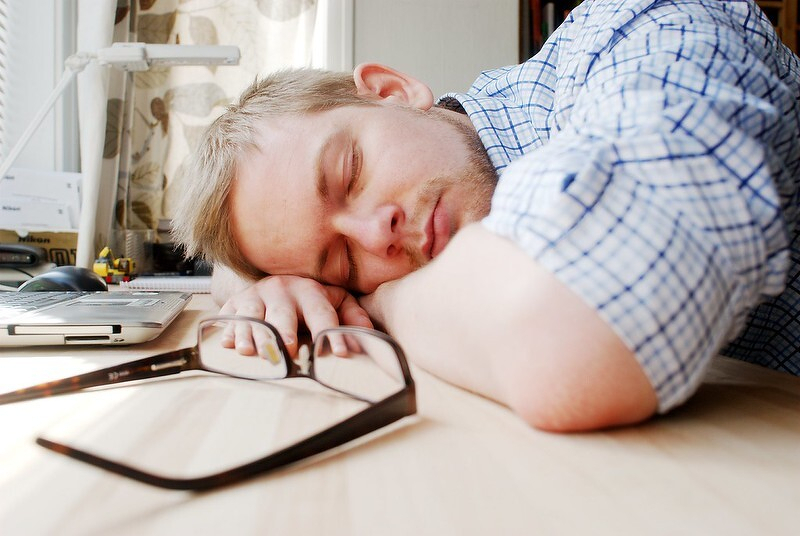
The photo above by Svein Halvor Halvorsen, “Last day before final exam,” licensed as CC BY-NC-ND 2.0.
In Israel, where I grew up, this was a sacred time in the day. You weren’t allowed to play soccer with your friends; you weren’t allowed to make noise. In kindergarten, you’re “strongly encouraged” to take a nap, or else.
This is slowly becoming a sacred time for me too. As time goes by, my struggle with the need for a “power nap” after 4.5 to 6.5 hours of night sleep is becoming something I’m comfortable with, a ritual I’m looking forward to. As a morning person whose creativity mostly takes place in the morning with a cup of coffee, which is why I blog in these hours usually (you’re welcome), it dawned on me last week that with a Shnatz, I get two mornings in one day. When I wake up from my nap, which is usually about 20 minutes, I’m energetic enough to exercise or tackle the more challenging tasks at work.
For too long, I’ve treated my need for an afternoon nap as a weakness or a problem. It’s been an issue I have to deal with, bundled with my insomnia. I started looking for a medical intervention but stopped at the last minute and asked myself for the 100th time: “Is taking a short nap really that bad, or are you just led to believe it is?”
I started to embrace it. It was hard, but I managed to turn off my phone for 30 minutes (isn’t that nuts when you think about it?) during my workday. Why 30 minutes? I give myself 5 minutes to fall asleep and 5 minutes to fully wake up.
No surprise, it’s working well - the difference is that now I feel better about it. I’m going to start scheduling it in my calendar. I’m going to stop being ashamed of it and start calling it a “life hack” instead, even though some of my friends call it “you’re just getting older, ya old fart.” Whatever! The result is the same.
This break is useful for additional things. One of those is to signal the time for exercise, as indicated earlier. I exercise at home, so I can do other things in between sets. I can also use this time to cook for myself, which I enjoy. A quick second shower, especially on hot days, is also a good idea, and with it, a good time to charge my Apple Watch. At the very least, it’s a good time to “reboot” my brain (hmm… a chance for meditation? Not a bad idea) and let my internal programming start fresh, with a new set of priorities.
If you get tired in the afternoon, I recommend you try it if you can escape somewhere for even 10 minutes. It doesn’t have to happen at exactly the same hour on the same day. I take a nap in between meetings or instead of my lunch (don’t need that much time to eat anyway). Sometimes I wake up rested after less than 10 minutes, other times I want to keep sleeping - but I find that 20 minutes or so is the sweet spot, and I usually wake without an alarm. So give yourself a Shnatz. You’re worth it.
A good weekend
Last weekend was good. I came to a realization not too long ago that most of my weekends are good, which is a good thing in itself, but I wanted to ramble a little about why.
My sleeping issues (I should coin the term somehow. “My Sleeping Issues” sounds like a terrible album name stuck on repeat at this point) meant that I woke up at 4, walked around for a bit, and went back to bed around 6. This pattern has been going on since last Thursday, when I pushed myself to be in bed at around 23:00. Seems like I sleep 5-6 hours no matter what I do, so if I go to sleep earlier, I wake up earlier without enough sleep. The good part? Going to bed around 6 again means I’m not a complete zombie the whole first half of the day, which definitely played a role here.
First off, there was a lot of Subnautica. With Part 2 out in early access, I saw Subnautica: Below Zero was on sale on Humble Bundle and snatched it. I never finished the first Subnautica (it was too scary, and yes, I need to get this post over to the new blog moved!), and I wanted to try again. Man, Subnautica is a treat. It was easy to get hooked again. This time around, I watched plenty of YouTube videos to help me out with tips, and building my underwater base was fun in a relaxing kind of way. There’s something about being able to organize a stressful situation that doesn’t let you breathe (literally in this game) into something safe that makes sense to you. And, yes, that’s also a metaphor.
I mentioned before I want to make some video content for gaming, but it’s not easy. Or rather, it’s a lot. I am no stranger to OBS Studio, but I had to re-learn to do a couple of things, and even then, going back and watching an hour or more of content and starting editing takes a lot of time. It’s a serious commitment. I haven’t given up on the idea, but I might change it around a bit toward a mix of writing and video content. I’m not sure yet. There are too many good games out there, and I don’t think there are enough places reviewing them from a personal perspective (by the way, let me introduce you to Laura Michet’s blog. She is a game writer/narrative designer, and she writes often).
Then I had a nice hangout with my partner, who works as an EMT. They are awesome in general (obviously I think so), and they recently got themselves a car, and driving in Manhattan is… well, let’s just say parking is one tough SOB boss. Imagine working a 9-hour shift in an ambulance, driving around (on a weekend, because during the week they’re busy with their other job), just to drive another two hours, the last hour and a half(!) of it is in order to find parking. They pretty much showed up just to crash and fall asleep, but then the next day, we went to the Farmer’s market together and drove around and walked the parks of upper Manhattan. It’s a sort of buffer, a break that makes my brain slow down a bit and appreciate my life outside of work and tech.
Which means that when I got back to my /own/ tech on Sunday, I was refreshed and full of energy. This weekend I installed Harper on my Linux desktop. Working through it but especially writing the post about it requires geek brain energy, which I just don’t have during the week. I really enjoy these projects; I learn more about stuff I’m passionate about, and it’s very rewarding.
I also wrote a lot in my journal, which I’m reorganizing, and it made me realize that, hey, I write a lot. Between my posts, emails to other bloggers, journaling, and experimenting with TiddlyWiki, there’s a lot of keyboard typing going on. This, as usual, makes me appreciate Emacs and org-mode, which has its own dedicated category. But that’s what happens when you can customize everything about a tool you use all the time: it’s a game in itself.
And now, with coffee done and this draft more or less complete, it’s time to get in the shower and quickly get some groceries before the work day gets the chance to kick my ass back into gear.
Lazy Chopped Salad
One of the awesome things that came out of me becoming mostly vegan since August of last year is the farmer’s market.
The walk there, every weekend, takes me about 40 minutes. It’s through the quiet streets and city parks of Upper Manhattan that stand in contrast to its otherwise loud and grungy surroundings. It’s not a particularly big market, just one short street behind a school, but the smaller selection of food (especially since I don’t buy dairy or meat products) motivates me to explore different ways to make food. 📷
One of my more recent discoveries was the extra-firm tofu, which they sell already cut into snack-size, water-free pieces. I sometimes just grab one right from the fridge and eat it “raw”.
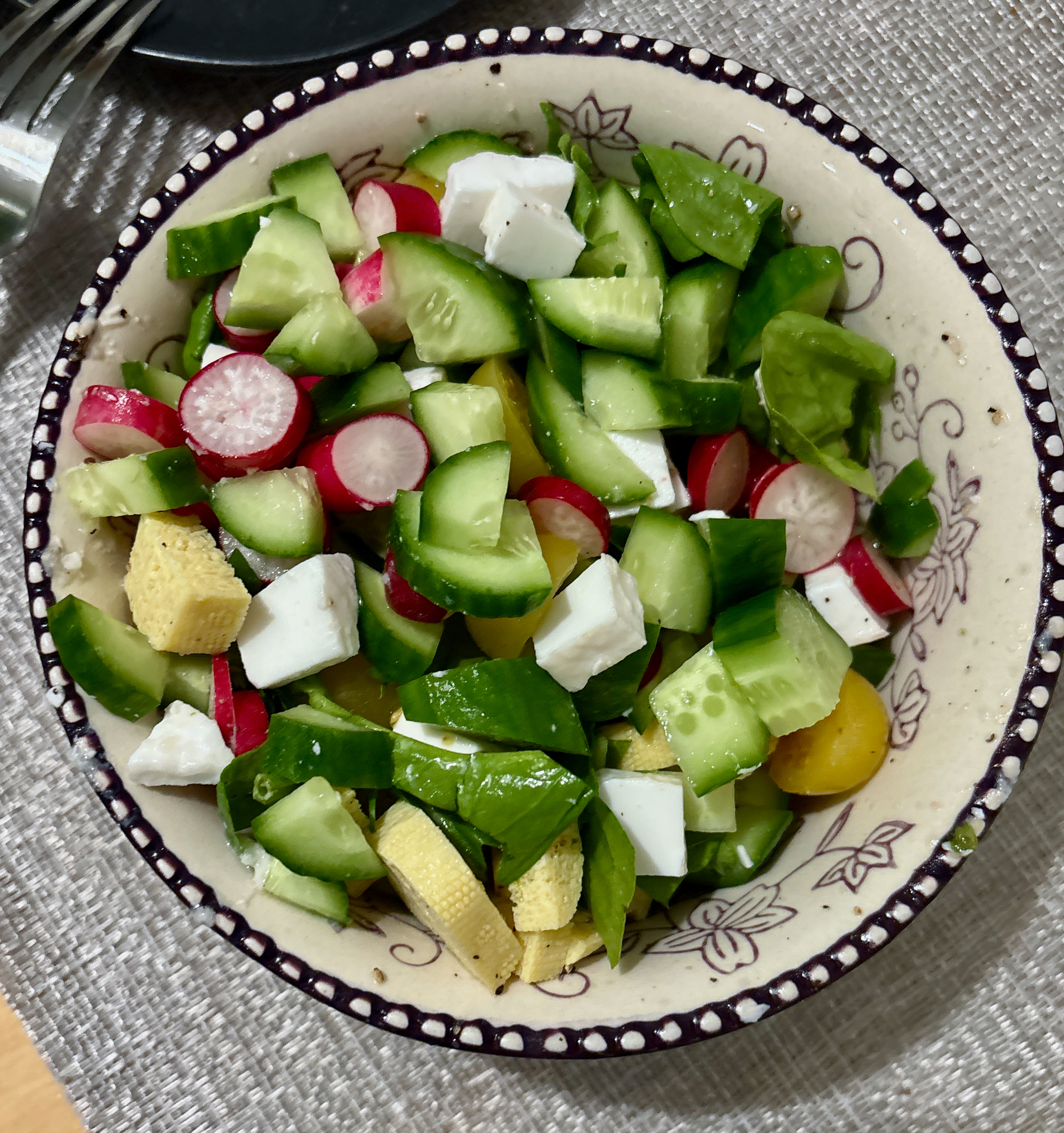
Lazy Salad
I call it “lazy” because of how I mix it, and also because I was too lazy to make more food. The tofu makes this filling enough, at least for me.
What’s in it
The cucumber, tomatoes (both not in season yet), and the lemon are from the grocery store. The rest is from the farmer’s market. My local store tries different varieties of cherry tomatoes, but I find the ones I like the most seem to come from Canada. As for the mini cucumber, I grab whatever they have because they often don’t have any. It’s a shame because these cucumbers are tastier, and their size makes them perfect for a quick addition to any meal, or even as a snack on their own, cut into strips with a small dash of spicy salt.
The difference a good knife can make
You can cut all these veggies with whatever knife you have, but it’s the chef’s knife I got not too long ago that makes me want to chop. Vegetables! I mean vegetables, yeesh.
With this knife, it’s easy to cut softer things (like leaves or tomatoes) without a problem. I did watch a couple of YouTube videos explaining a few cutting techniques and how to hold the knife when I bought it. While I’m /far/ from being an expert, I recommend you also watch a couple if you get one. You don’t want any fingers in the salad; this is a vegan recipe after all.
You can see from the picture that I didn’t chop anything too fine. Big enough to stab individual pieces with a fork, small enough that it fits in the bowl you’re going to eat from. Fast and easy.
Middle Eastern salad seasoning
I think most if not all Middle Eastern salads use three main ingredients when it comes to making the salad “dressing,” or as I call it, juice, because that’s what it is. It’s just lemon, salt, and black pepper.
I recommend you find a place that sells black peppercorns that you can grind yourself. You can taste the difference immediately. I get my black pepper at the same place I get my coffee beans (along with the salt, pink Himalayan, which I grind also, but that’s not as important). As for the lemon, get a real one and squeeze it with your hand over a strainer, or get a lemon squeezer. I love my personal portion with half a lemon, but this might be too much for you, so just squeeze it into a spoon and use that if you want less.
Mixing
Add the salt, the pepper, and the lemon on top of the salad. If your bowl is full of salad to the point that pushing a spoon in to mix it means you’ll end up spilling stuff over (as the case was for me), just cover it with another bowl, upside down. Then, above a sink (because some juice will spill out), carefully turn the whole thing over, and back - do this 3 to 5 times, and… it’s ready.
You could make the salad in a bigger bowl and mix it. Actually, you can also use your hands (you washed them, right? And you use them anyway to chop the veggies, so you’ve already touched everything). It is sometimes easier to “massage” the salad gently.
Stuff to change around
You could easily substitute vegetables in the salad depending on what’s available. A red onion (I’d do half) instead of the radishes, or perhaps some Seitan-based meat instead of the feta cheese or the tofu. You could also add almonds or pine nuts to the mix if you feel fancy (want super fancy? throw the pine nuts into a frying pan and heat over low for a few minutes to toast them lightly). You can change the portion or how fine you cut also.
Re: Who Knows That You Blog?
David at Forking Mad + asked: “Do you tell people you blog?” which also made its way to Kai. I saved both posts in my Bookmarks (which is Micro.blog’s take on ‘Read it Later’/Pocket) and planned to answer at some point, but then David emailed me the other day and reminded me of this question.
David’s take is that if it shouldn’t be public, it wouldn’t end up on his blog. Kai is more or less of a similar opinion. For me though, I think the answer is a bit more nuanced.
I don’t use my real name on my blog like Kai or Kev. JTR is totally made up. It wasn’t always JTR: it evolved over the last 15 years or so, give or take, and it stuck.
Back when I started writing, my posts used to be more R-rated, and the places I worked at weren’t the kind of organizations that wanted to associate with R-rated material. It wasn’t anything offensive (I don’t think), just… uncouth.
With time, both my workplace(s) and my posts changed to meet in the middle of that spectrum. I work for a big medical center in NYC, and most of my more mature-oriented posts are philosophical, not the dramatic angsty kind. Some of them can still raise eyebrows probably, but I imagine most people would just shrug and move on if they’re uncomfortable. There’s a lot of stuff on this blog, and these kinds of posts are just another dash of flavor to the overall theme, so I feel it’s not such a big deal.
At the same time, I don’t usually tell people I blog. My partners know, my sister knows (I send her a few links here and there for my thoughts), and while my parents know about my blog, both language barrier and lack of interest (I ramble about tech most of the time) mean that they don’t really read it. And if they do and find something, well, my lifestyle is already unorthodox enough for them to just sigh and shake their head and move on with their lives.
So yes, nuanced is a good way to put it. My relationships with different people and the topics I write about mean that some people know I blog, but most don’t. I don’t keep this blog a secret. If someone really wanted to find out my real name, they could find it easily enough. At the same time, it does require some work; it’s not exactly the kind of information you’d get straight out of Google (at least I don’t think so), but then again, if it happens, not the end of the world.
That’s the other thing I started realizing not too long ago: I stand behind who I am today in a way I haven’t in the past (and couldn’t). My about page says I’m non-monogamous for example, and I mention in a few places I see myself as a queer person simply because I don’t identify as a “straight” man (but I don’t see myself as gay, bi, or all the other fancy labels which I don’t care much for).
While this might sound like too much information for a simple question like “who knows that you blog,” I don’t think so - at least not in my case. That’s because I write about these things, which means I should at least be open to a conversation about them. Maybe not with every person (it is personal after all), but in general, it’s not a blocked off category. By the way, I don’t think this means every person who writes about personal things should be open to a conversation about them. It’s a choice.
While I am generally open about my life (at least what I write about here), it doesn’t mean the people I write about are. When I mention my partners, I have their permission to do so. I can be a bit absurd about how explicit I make it sometimes, because I want and need to be sure they’re OK to be mentioned.
And a final note, in line with my recent posts about emails to other bloggers: I’d like to think of myself as a ‘safe person’ to talk to about these things. If someone is reading this post somewhere and feels a bit alone and/or against the world being somewhat different, be it LGBTQ+, neurodivergent, non-binary, or whatever, and feels like they want to reach out, please do. You’re my people, people. Feel free.
Well, I think that was a rather long and complicated way to answer a simple question, but I do tend to do that. Be good, and have a good night!