It is here. I’m part of the ⌚ cult now.
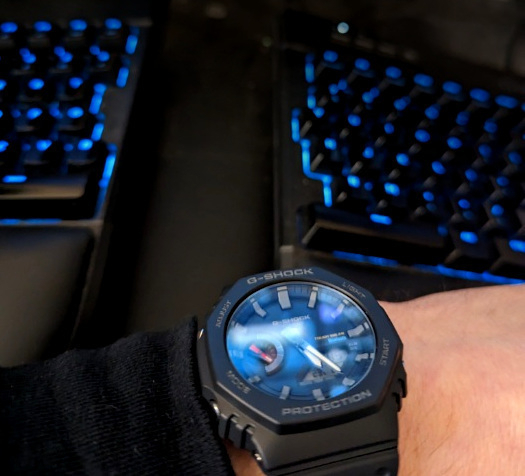
Now to get a nato band before I scratch my wrist off.
Maybe it’s because I drastically lowered my sugar intake in foods and drinks 🤔, but I can tell the difference between different kinds of seltzer 🥤
Good morning 🌞 What is the plan for today?
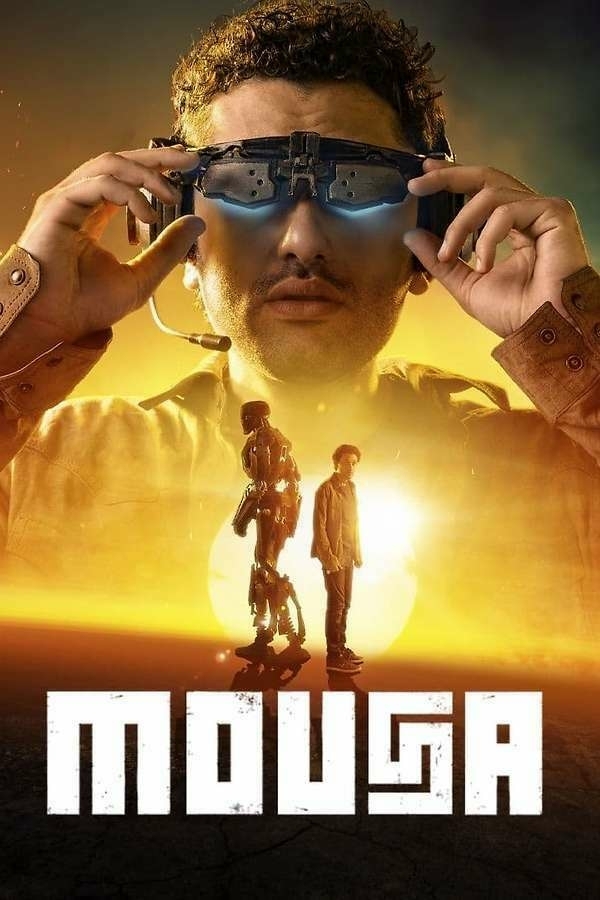
Mousa, 2021 - ★★ (contains spoilers)
This review may contain spoilers.
Mousa's has a problem. Its main actor, Karim Mahmoud Abdel Aziz, is trapped in a crappy movie. Such a waste.
The settings of the story are not too bad: a gifted but socially-awkward challenged electrical engineer has a tough life at the university. He lives alone with his father and has an interesting relationship going on between them. Yehia (Karim) has a possible love interest(s) (it's not obvious with Yehia's shy approach, which makes things more interesting), and as he tries to maneuver those with the guidance of his sympathetic father, things go bad.
Unfortunately, things go bad not just as part of the plot, but also for the whole movie, which flatlines to a dumb terminator-turned-a-good-guy superhero flick. (Spoilers alert)
The bad guys show up for some vague reason, steal money and watches (the father was a watchmaker), and run, let the father die in a fire. Yehia, paralyzed in fear, has to watch his father die. He survives the fire and comes back, sells the house, and decides to live in the lab (the "hut"), and build a termin... sorry, a remotely-controlled robot who will avenge his father's death.
It doesn't take long before his engineer-woman friend shows up. She hacked Yehia's computers and knows his secret, but is somehow too dumb to figure out how to fix her car. She convinces Yehiya to go beyond simple revenge for his father into a full vigilante and go after the bad guys. There's a professor at the university who has some jealousy issues with Yehia also. I'm pretty sure he will become the nemesis, but I won't know because I stopped watching after the second skirmish between the term...err, robot, and the bad guys.
The robot animations are bad. Not awful, but seem to be a couple of years behind. I'm sure the producers don't have the budget Hollywood movies do, but I've seen better animations made in Blender by college students in their free time. That, however, I can forgive.
What I'm grumpy about is the waste of talent and story. I'mYou have a good actor who plays the role beautifully. The character is smart and capable. There's also a gifted woman who happens to be a hacker. Why not use that raw brain power on the bad guys? Do some more flashy matrix-rip-off hacking? Why not develop on the complex relationships Yehia has with his peers? Maybe give the father more of a role somehow? Anything is better than the bad guys. They are so flat and boring, evil robots would have more personality.
Director [[https://www.imdb.com/name/nm5394027/][Peter Mimi]] is rushing to get to the juicy action part and leave the "boring" introduction as soon as possible. The problem is that the juice reeks of rip-offs and cheap effects with zero depth. The only good part is the rushed introduction.
Too bad.
Took a walk earlier today, and started to see the beginning of spring… 🌻 🌷 It was good to snap some pictures 📷 again.

Writing in a notebook after all this time
My pocket notebooks 📓 showed up earlier than I thought, and I was eager to write some thoughts down over my morning coffee.
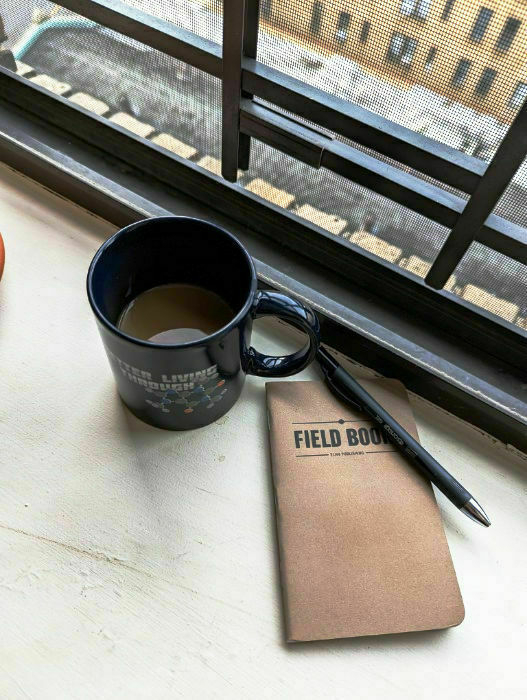
A couple of things come to mind so far:
- My handwriting ✍️ is (still) horrible. I can barely read what I write. If I wait a week, I’m sure half of the stuff will become indecipherable.
- It’s slow. Not terribly slow, but much slower than dictating my thoughts to text, as I do with Orgzly. Slowing down, however, can be helpful.
- I worry about losing my written thoughts. they’re only written down in once one place, after all.
- I can sketch! I can draw! It’s so easy to add arrows or emphasize words! This also showed me that…
- …I suck at sketching. Not a shock there.
- I enjoy the feel of the pen on paper, and this notebook is too small. I know what writing in a good (and flat) notebook feels like, and this is not it. I also have better pens I should use.
As with everything else, I can’t expect results overnight. When I kept a written journal, my handwriting was slightly better. I remember teaching myself to slow down and connect my letters correctly. It was painfully slow. I couldn’t keep up with my thoughts at all. I gained speed eventually. Writing was about discipline and stubbornness; nowhere near to the extension of my brain org-mode is for me these days.
Despite all this, I hope I can still find a compromise. I know that can I enjoy writing and sketching. It’s a matter of balance and time. I guess we’ll see.
I decided to use a KVM switch with my Mac mini
Over a hundred techies responded to my question: “folks with Linux and Macs, what’s your ideal solution to work on both?” That’s a lot for a quick 3-day poll.
From the look of it, most use a physical KVM switch, which is also what I opted for. I had one that I hadn’t used in a while, and I was happy to see it’s still working.
Here it is, in all its… glory…
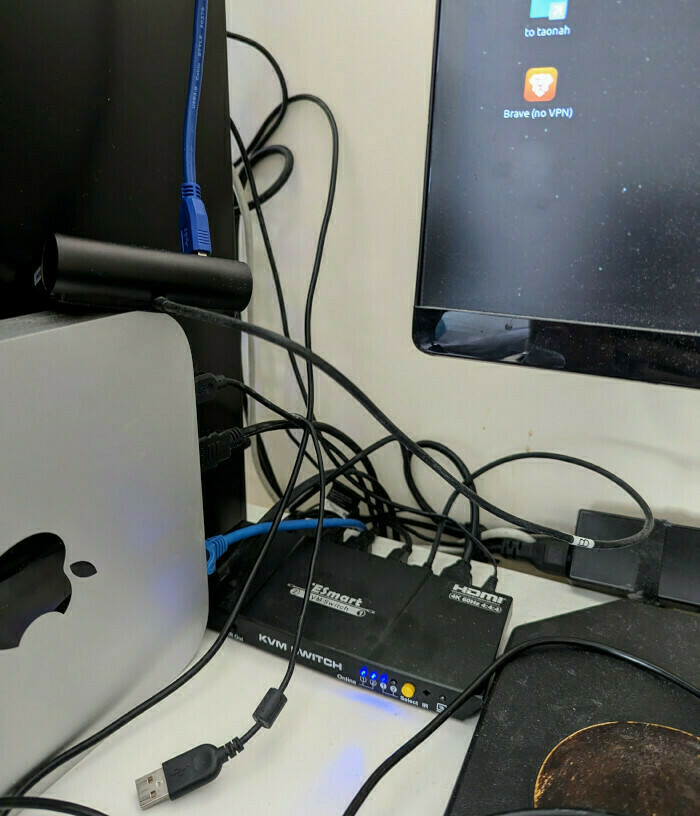
OK, I know! The wires! It’s screaming for help. I just finished plugging in everything to make sure it all works. I wanted to test different peripherals, and having a moving standing platform (screen and keyboard) is tricky.
Factors in favor of a KVM switch:
- I already had one, so I wanted to try it out
- I have one screen and one keyboard (though I also have a magic mouse for the Mac)
- I wanted to listen to music on the Mac, so that ruled out plain VNC
- I want to work with movie clips, and VNC can be a bit slow with animations
- This being a work machine, I feel better not installing any more software than I already have on it.
So far, it works better than expected!
When I tried the KVM switch with a different keyboard, it didn’t detect it in the dedicated keyboard USB. I believe this happens with some gaming keyboards. My current keyboard works without an issue. I can use the USB port on the switch to plug in my headset, which allows me to rock to AC/DC (or Bruckner, depending on my mood) while working.
However, Plugging in a USB hub to the KVM switch so I have more than one USB port available, causes issues when connecting additional devices. I’m not an expert, but daisy-chaining a USB port to a USB port to a USB port will is probably not a good idea. Fortunately, I think I can get by plugging peripherals into the computers directly.
I plan to try it for a week or so and see what problems I run into. The Mac is my primary work machine, which allows me to be even more productive away from the office. It also means my Linux machine is free from all kinds of propriety software from Microsoft.
I need to clean up the wires and I’m good.
So after I broke my micro.blog by mistake with a youtube video, I guess I should try to upload my own.
In this video, I play Oxygen Not Included, one of my favorite games of all time.
This video’s also on PeerTube, though I’m not sure for how long.
It's official: you don't need to buy books to play DnD
Dungeons and Dragons (DnD) is a game that happens in the mind. There are many props (which you still need to buy with money), but none of them are required. You don’t even need to use dice if you’re creative enough. When I was in school, we rolled a pencil on which we wrote numbers or just let the DM decide the outcome of certain things. You just need friends and a way to communicate.
I can go on about DnD, what it is, and how it’s played, but there are many people that do a far better job. As a matter of fact, the company that publishes DnD now does it for free. Indeed, The rules for the game, the same ones in thick rule books, are now available on the same website. You can download them and start playing with your friends today.
To understand the legal status of things (DnD is now under creative commons) better, I found this YouTube video helpful.
In my mind, DnD was always free. It was the one game that frees your mind and lets your imagination run wild. I purchased some of the rule books as I was going through different DnD periods in my life, but I never hesitated to make a rule on the spot, be it because I forgot or couldn’t find the official rules or because making up rules was more fun.
Like Linux and Emacs, two of the most significant tools in my life today, this important game is also free. Because of this license and the huge community of players, it’s even possible to make a living playing the game. Not just by teaching it, but also by developing it and building additional content. Doesn’t it sound a lot like Linux/Emacs and the content different YouTubers make explaining it? I don’t think this is a coincidence. There are excellent players and DMs out there (Critical Role needs little introduction), and now it’s easier than ever to join them.
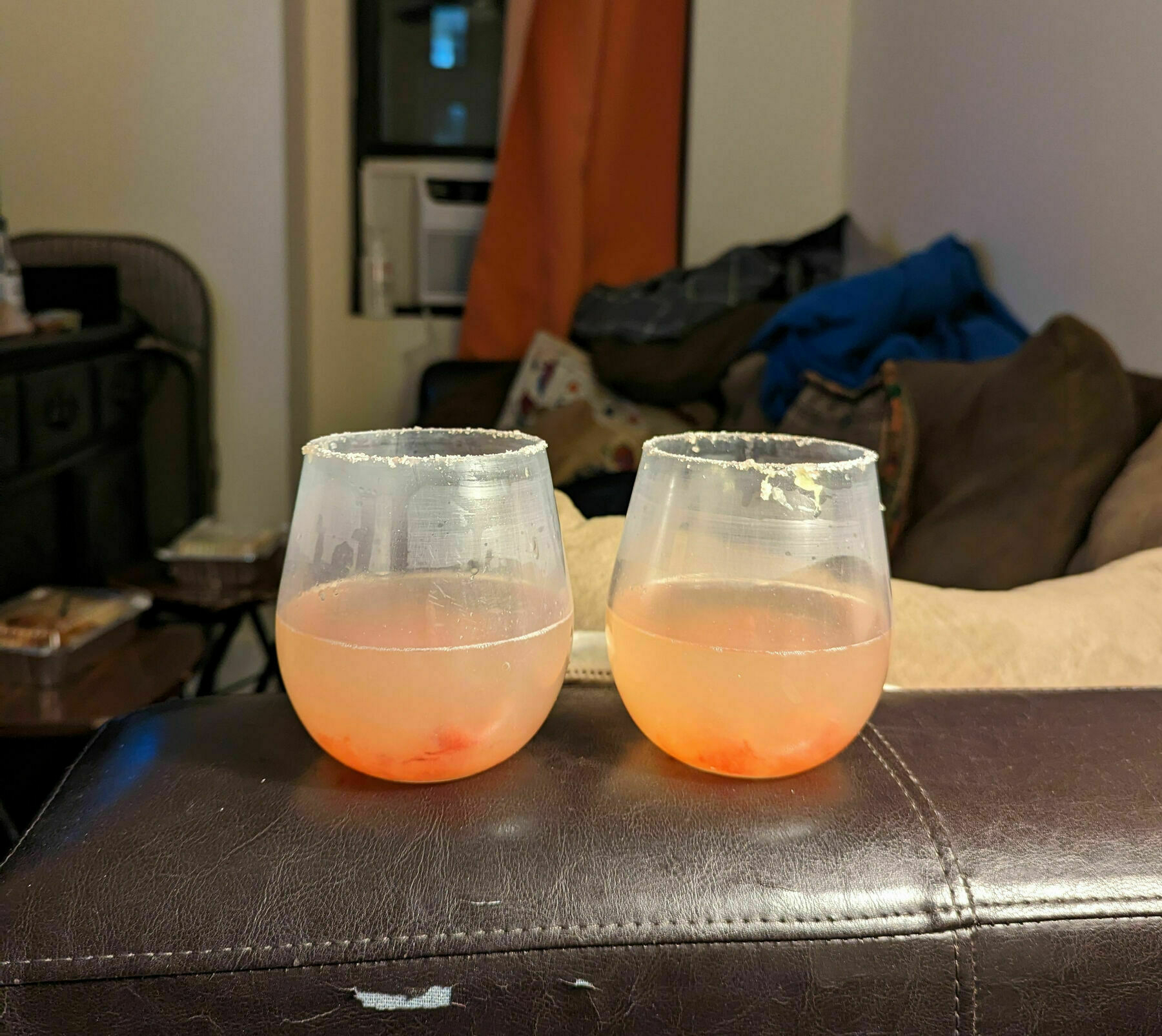
My partner keeps outdoing himself. Check this out: homemade peach plum margaritas and The Last of Us. Chunky bits in the drink and fungous zombies on the screen… mmm. Delicious.
#100DaysToOffload is not my thing, and that's fine
I was looking into trying out the whole 100 days to offload business. Everyone’s doing it, I have a blog, so I should do it, right?
I like the idea behind 100 days to offload (let’s call it 100dtol). The goal is to get people who always want to blog to just freaking do it already. In 100dtol’s own words: “Tell us about your dog, your cat, your fish tank, or whatever hobbies you have. Someone will find it interesting. Just. Write.” This is a good way to start writing, get into the habit, and hopefully keep at it.
But I’m not starting out. I’ve been writing in one capacity or another for the last 20 years or so. It’s a way of life at this point: I have to blog. I don’t know how not to write. The need to write the words you are now reading seems to make time for itself, no matter how and where.
You know something else? I’m also not that good at it. Sure, I’m better today than I was 5 years ago, but I’m just better at it than I once was. That’s all.
As someone who constantly has thoughts floating around in his head, figuring out which thoughts to catch, tame, and then let out to the world is a big part of the process. My way of writing doesn’t fit into the “just write” bracket anymore. This post you’re reading right now? It started out as an outline. Here, have a look:
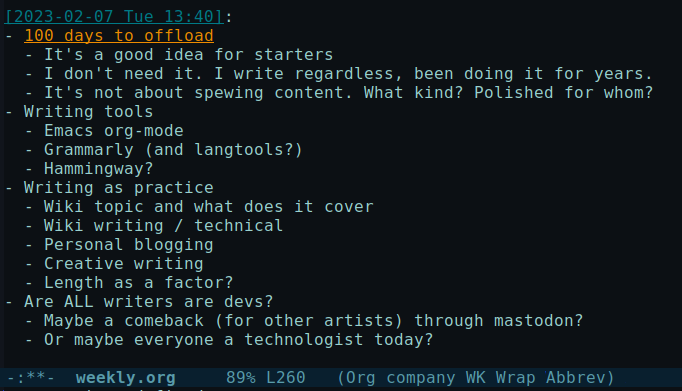
This does not include editing (at least a few hours if not a day later), checking for errors, publishing, reading the live post, and cringing at the typos that somehow made it through. Oh no, there’s no “just write” anymore. I’m past that. it’s gone baby, I’m hooked. I’m a writing addict.
So with all due respect to 100dtol, which I do have, it’s not for me. And that’s fine.
I have a couple of things to say about writing 📝. More than a couple of things, actually, that’s the problem. If I start venting right now, I’ll be at it for about an hour, and it won’t make much sense. I need to break it down.
Good morning, ☕ from me and Allo
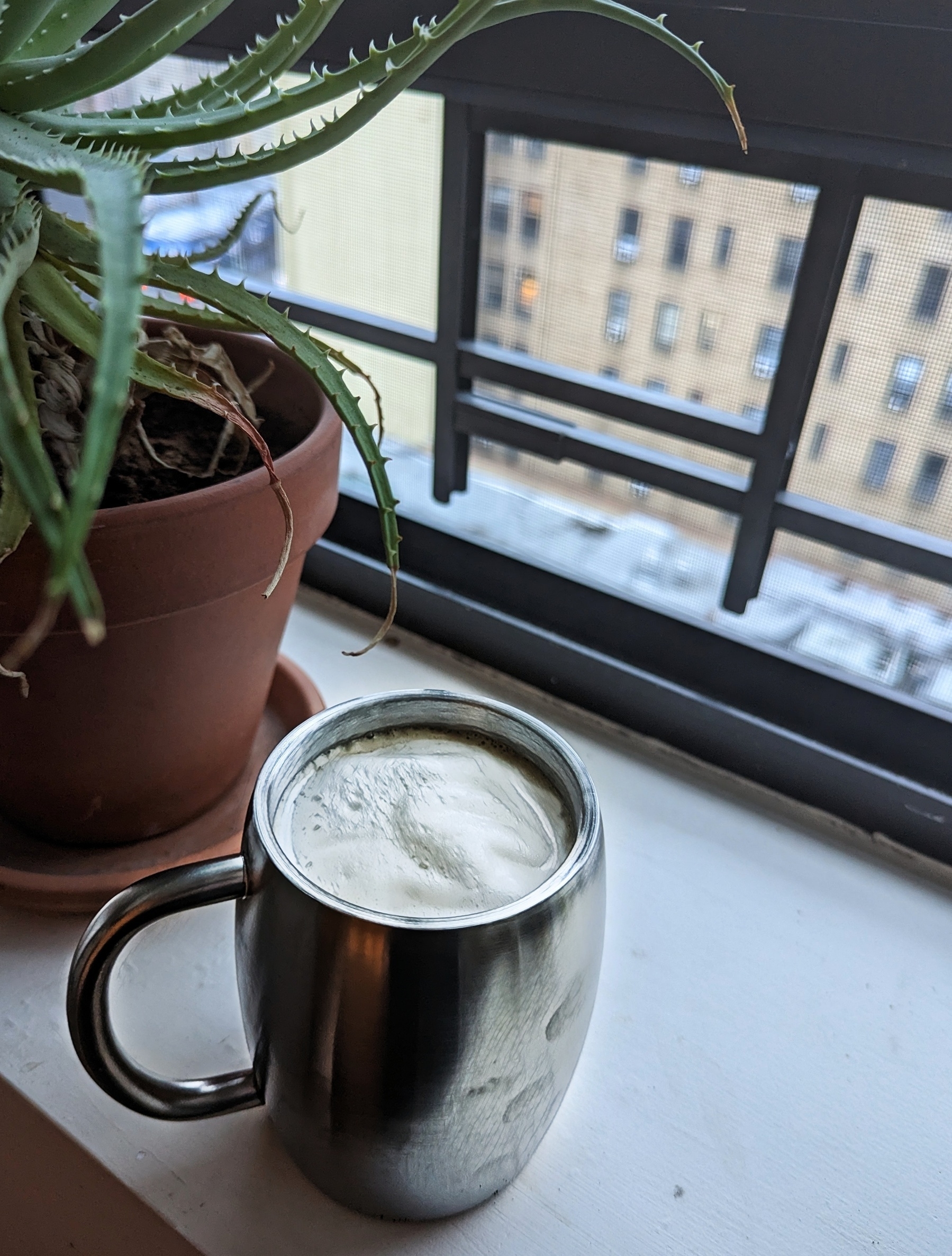
Time to leave the apartment to shop for some groceries and stretch my legs. This cold had me stuck in the apartment for two days..!
The guilt and benefits of working remote
Wednesday afternoon. I wake up refreshed from a 10-minute nap. It’s cold outside, but the sun’s shining through my window unto the bed. I enjoy the warmth a minute longer before I get up to sit at the computer and keep working.
I fight feelings of guilt and worry. The way I’m conditioned to work - the way most of us are - is the usual 9 to 5 an hour for lunch. Even at the peak of COVID, I used to come to the office every morning, since I was a part of an IT team in a hospital.
I’m worried they’d think I’m lazy. I’m worried someone will call me with an emergency and I won’t be near my phone. I’m scared of making a bad impression in my new role.
I know it’s not true. Many of my co-workers are remote, even with COVID regulations easing off. We have office days ( which I find useful for focus and equipment I don’t have at home), but the office is mostly empty. The kind of work I do nowadays is through a web portal or a VPN connection. The meetings are all on Zoom, with screen sharing and colorful backgrounds. I sync my projects through OneDrive, my bookmarks through Microsoft Edge, and my comments through ServiceNow.
Mostly there are benefits. I’m able to work in “chunks,” which makes more sense for the project-oriented nature of my work. I’m able to use Emacs and run shell scripts I build at home. I can take care of apartment issues and get groceries delivered instead of worrying about those later. I can do my exercises between meetings and do a quick round of Doom to get my energy pumping. This all means I have more time and energy for my projects at work.
This new work-life balance means I have my work phone with me at all times. I am not required to be available 24/7, but it’s good to have a finger on the pulse so I can jump in and get involved as needed. My co-workers know they can message me anytime and I’ll get back to them sooner than later; the other day I received a message around 10 PM for a quick correction after which I went to bed.
My day starts at around 8 after I wake up and have my coffee. I go over emails, various ticket queues, and Slack, looking for urgent issues. Then I write a bit in my journal, take a shower, and start working on my projects. By this point, most people are around to chat after the morning rush eased off a bit. Likewise, in terms of meetings, the day ends somewhere after 3 PM. I usually eat a late lunch and work into the evening on solo tasks. This is also a good time to write emails and follow-ups for the next day.
This experience is new, a combined result of COVID and changing positions at work. As I noted at the beginning, I’m still getting used to it. I wish the guilty feelings would go away. It’s not easy to let a habit go, one that goes back years, even decades at this point.
For some, this way of mixing personal life with work is bad for balance. I get that. However, to me, it seems this new way is benefiting me and my job. I get more time for myself because I can adjust my time slots to fit my needs. In turn, I feel more productive and I don’t mind working outside of work hours, even on weekends. Since what I do for work is similar to what I do for fun (writing about technology, asking people questions, learning to edit video content, etc.) it’s even easier to go back and forth between the two.
From LastPass to KeePassXC - a quick import/export guide. Recycled and refreshed from my old blog, now on the wiki
About getting tips without getting paid
I updated my About page. I added a blurb about this website, mentioned my wiki, and cleaned up a little. But what I actually want to talk about is the “give me money” part.
First off, I don’t blog for money. I don’t write articles on my wiki for money, and I don’t plan to charge for video content (which is something I’m trying to do more of) either. While I put time and effort into everything I mentioned, I’m not interested in money in exchange.
What is more valuable to me, and has been throughout my technology quest for the last 8 years or so, is information. I love sharing what I know and I enjoy getting information from others. When you read something I wrote, you can comment and share your thoughts. Information in the form of interaction.
That said, money can express gratitude. Tipping. It’s even called gratuity. I have Liberapay and Ko-fi pages on the About page. Here’s the idea:
If you enjoy what you read, visit my sites often, and find them useful, you can express gratitude beyond simple interaction (I always love hearing from other folks on topics I’m passionate about, don’t you?). Leave me a tip. This is not sponsorship.
A tip does not mean I’m going to adjust my writing to someone’s liking because they tipped me. That would be payment, which I refuse to receive. Please don’t subscribe for a monthly donation either. That’s not a tip, that’s trusting me to have something worthwhile to say every month. I can assure you, I don’t. Thankfully, I do not need financial support. Please donate to other organizations and people who need this money more than I do. If at one point I will work on a project that needs support, I will let you know.
I tried to stick with Stripe and options that can leave you anonymous. PayPal, for example, will reveal your email address. I don’t need to know who you are if you don’t want to tell me.
…And that’s about it. I’ll step off my soap box now. Enjoy your stay!
CaptainLog - this time a PeerTube video
I’ve made a couple of changes to my Wiki, and CaptainLog is overdue for an update. Since I’m trying to push myself to do more videos (to get practice doing them and to get over the issue of showing my face), I thought I’ll try to do just that.
It’s quick and potentially pretty boring, but hey, it’s something. I’m probably aware of the issues you’d notice right away. Other than that, video embedding with PeerTube works great and uploading the video was faster and easier than it will be on YouTube.
Well, here it is.
Hello @eludom@fosstodon.org this is JTR from Micro.blog, you should see this as JTR at my domain. And while I’m at it, I’ll experiment on some other willing folks who do not know they are willing yet: @joel@fosstodon.org @adamsdesk@fosstodon.org @jack@baty.social
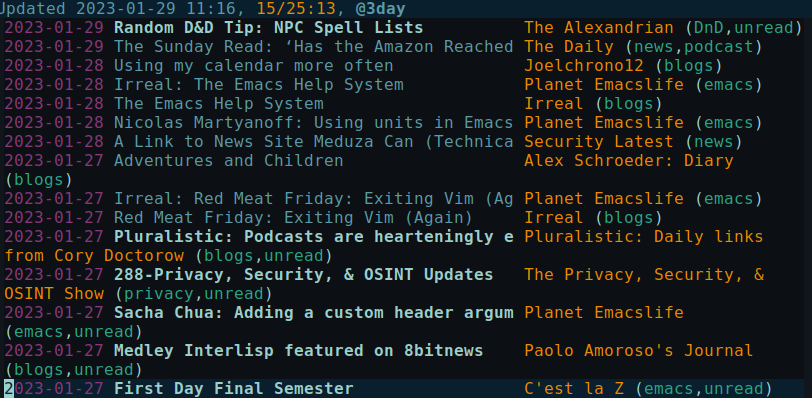
Cleaning my RSS subscriptions. I forgot how nice it is to read personal blogs.