
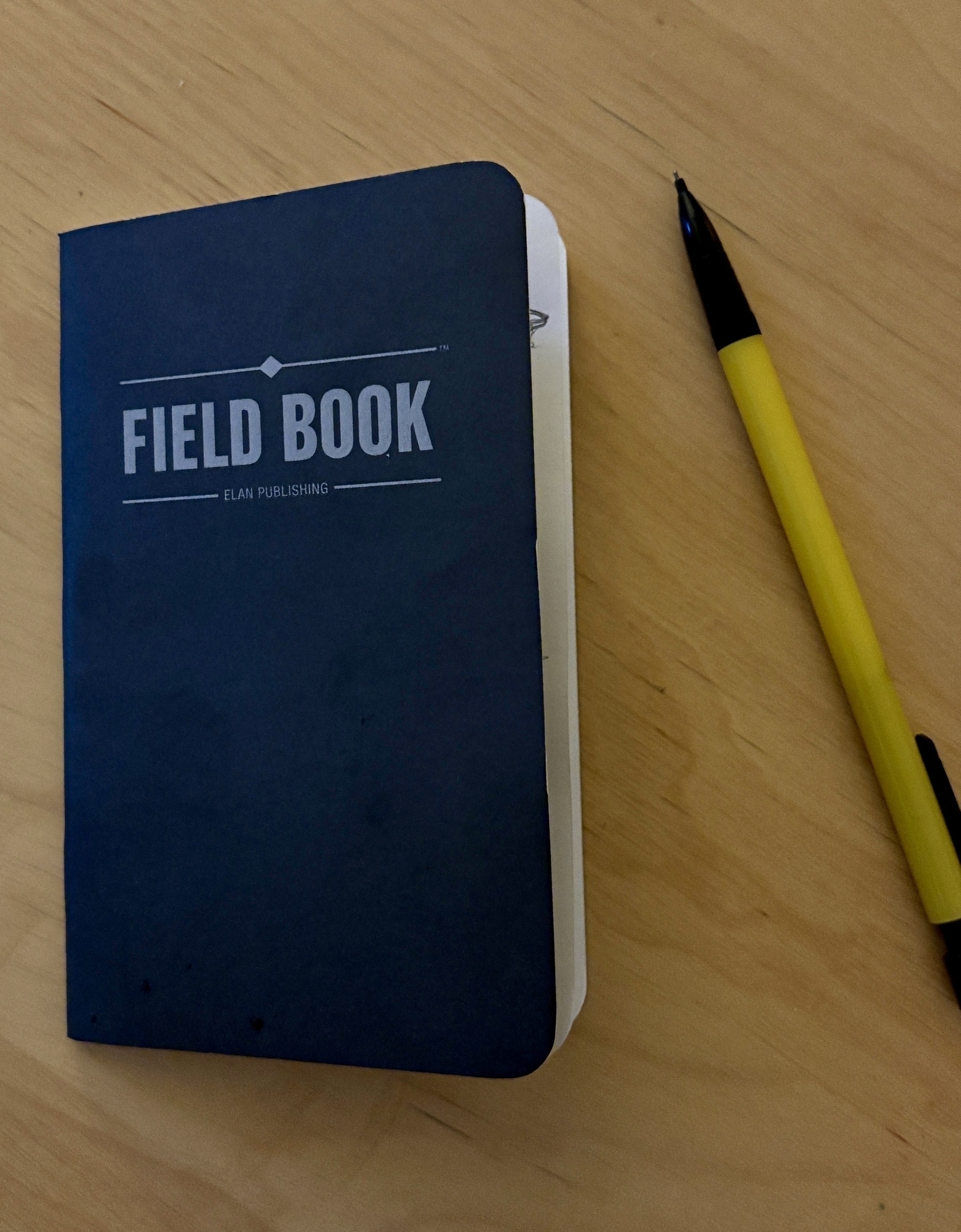
After waking up several times with thoughts and brainstorming sessions during the night, I decided to work with a pocket notebook 📓 again. 📷
Unlike my phone, it doesn’t have emails and messages waiting to grab my attention, or a screen to shine into my eyes.
I can’t believe it’s already been two full weeks since I shifted into this new role at work, but here we are. I was called in by someone high up who knew me well from my previous position. He offered me a managerial role in my old department, where I cut my teeth being IT*
While the title itself will be discussed further, and while I do not manage anyone directly (I’m probably not going to be anyone’s direct boss), managing things is, pretty much, what I’m supposed to do. It requires much more understanding of day-to-day IT operations than I ever had before, and I am truly grateful I’m surrounded by people I already know who had the patience and knowledge to teach me in the past.
On a personal level, this means my daily schedule goes out the window. It already did, as I hit the ground running. Some operations can take place only early in the morning, while others take place on weekends (those of you who do patching know what I’m talking about). On the other hand, the bulk of the work usually slows down in the afternoon. My remote work options are also shifting, as much of the work I’m doing so far involves meeting people - new and old - in their different locations, and access to certain systems means I need to be on-site.
My brain has been firing on all cylinders and then some. I woke up at 3 or 4 AM for several days right into brainstorms, which ended only after I wrote down notes or sipped cold seltzer while looking out the window at lit windows around me in the city.
Sleeping was so bad, in fact, that I decided to try some “Not Pot” CBD gummies again. It helped to a point. This is a rough transition. Not only am I dealing with a role I haven’t done before, and there are many more responsibilities, but I am also still in my old role. While people around me understand if I need extra time, we don’t always have that option. Things need to get done.
I’m no stranger to changes such as this one, and I have faith in myself that I will not only manage to deal with everything eventually but also do so well. This is not out of boasting or showing off, but because I know myself. I care to know, and I know to care (sometimes too much). There is a cost in time and energy, and I need to remain aware.
Writing here helps somewhat; thank you for reading. If the blog slows down, I believe it will only be temporary as I adjust.
While this wasn’t my first position in IT, it was the first serious one where I learned and grew in this career.
An opportunity showed itself at work and I grabbed it. It’s been a lot of work, since I still have all the responsibility of my current role while I’m stepping into the new one. Writing here slowed down a bit as a result, hope to write more tomorrow.
Good night all, hope your week was exciting!
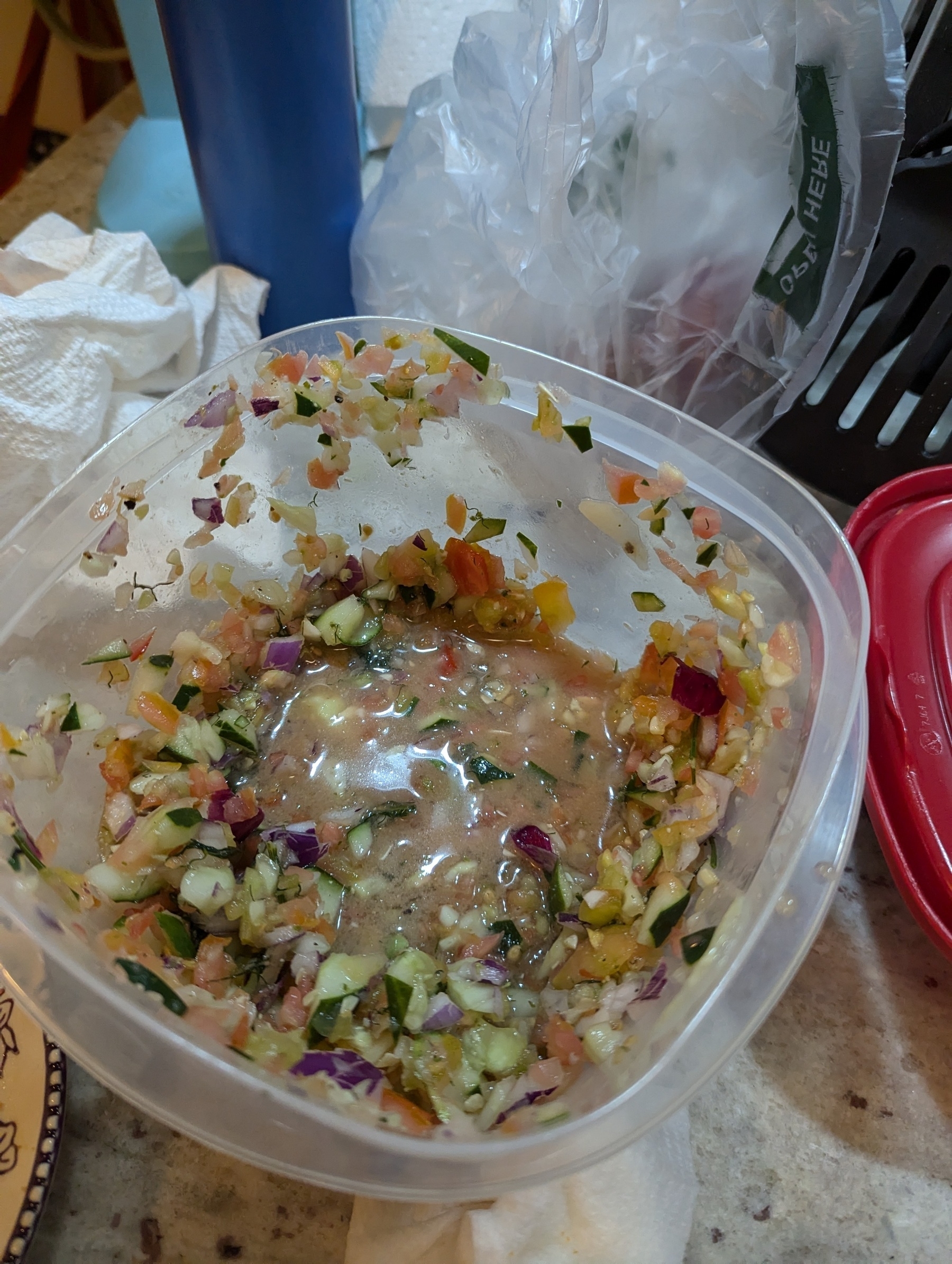
So I made the salad from fresh farmer’s market vegetables. Cucumber, tomatoes, red onion, garlic, dill. All fine cut with a manual shredder I got as a gift years ago. Very juicy with lemon, salt and pepper, this qualifies as an Israeli salad.
I’m not an art expert, but this looks like a piece of junk they pulled out of the water. It’s an eyesore in this otherwise green park. 📷


I’m not a big cook, but I used to make some things at home. Salads, homemade hummus, guacamole, pastas… I’m getting tired of sandwiches, and cheese is not something I do as well anymore, so I think it’s time to get back to some of those. 🥗🍝🥑
What is or why Emacs?
My “Emacs day” is July 11, 2018. Or in org-mode, it looks like this: . As I noted last year at that time, it is the day I wrote my first official journal post in Emacs org-mode, and the rest is history. I’ve been a daily Emacs user since that day.
Both my partners joke about Emacs. NK calls it “Immaculate.” When I asked them this morning to guess what I was going to write about, they rolled their eyes and nailed it on the first try. At the same time, Nat and I have “venting sessions” where we sit down and talk about work and life. If there’s something that’s too complex and I need their patience as I unfold a story, I lead with “Well, this is kind of an Emacs vent, but…” and Nat knows to brace himself.
But what the hell is Emacs, anyway?
I’m not sure I explained it in a way that makes sense. The problem is not explaining what tool Emacs is or what kind of software; that’s pretty easy: It’s a text editor, like NotePad, TextEdit, or that horrible, well-known Microsoft Office one I dare not associate with Emacs in one sentence. Asking what is Emacs sells it short and doesn’t explain why so many people swear by Emacs every day. Perhaps a better question is why. So, as the blog’s title suggests, don’t ask why; I’ll explain anyway.
Some people compare Emacs to an operating system of its own, which makes sense: it comes with so many built-in tools you could fire it up and probably do all of your computing work without ever exiting it. Well, in a command-line computer-geek kind of way.
Some of the things I use Emacs for all the time, besides writing, of course (it’s a text editor, remember?), are to navigate and operate my Mac’s files, read other blogs I subscribe to, check my calendar for events, and manage my projects and todos. I do all of those inside Emacs. But even so, why not just use my Mac’s tools or Windows if I were to use a Windows computer for my productivity?
The answer, which may not make sense to you if you’re not an Emacs user, is that Emacs is quicker and simpler and thus better for me to use. The key thing is that if it’s not better to use for something, I can manipulate and customize it until it is. My Emacs is made for me, and if there’s something I need to change so it fits better, I can do just that. Emacs is completely customizable, which means you get to tinker and manipulate whatever you need until you get those tools to work exactly the way you want them to.
Imagine you get up and make drip coffee. You grind your beans, fill in water, carefully place the filter with the grinds, and turn it on. Now, imagine that turning on the coffee maker doesn’t only start brewing your coffee but also turns on the toaster with two slices of fresh bread and also displays a crossword puzzle automatically on your phone. Not only do these things happen automatically, but also the bread is always toasted the way you like it, the coffee is automatically dispatched from your favorite roaster, and the crossword puzzle is tailored specifically to a level of your liking. On top of that, to continue with the metaphor, you can always make changes (change the coffee type, for example, so you make yourself a cappuccino instead of drip) quickly and easily, and the knowledge and ability to do so is completely yours to do whatever you want with it, for free, forever.
If you could do all of that, would you still go to Starbucks to get your coffee?
Sounds almost like magic, but for a computer, that’s what Emacs is. You could use it to read and write emails, look at maps, browse the web, listen to music, and over other 5000 additional things that exist just in its main library (it’s not even the biggest one). All of those are available for free, code and all. When you’re an Emacs user, all of these functions are available to you with the same ease - and keybinding - that your fingers are already used to.
Perhaps now it’s a bit easier to understand why Emacs is difficult to explain. It’s not just another application. it’s a lifestyle. To me, it has been the ultimate productivity hack - and it keeps getting better.
A couple of days ago, when I left the apartment to do shopping, I consulted Carrot, which told me it was cloudy but not raining. So I left my umbrella behind, just to be greeted with warm summer rain. I signed, took the elevator back up, snatched my umbrella, and went outside again. By that point, the rain stopped. That evening, I uninstalled Carrot from my Apple Watch.
Perhaps it’s my fault for changing Carrot’s default weather source to include one that can also tell me the amount of pollen in the air, sure. But for all its complexity, I still didn’t figure a layout that works for me. I need to browse different menus on the watch and the phone to get the information I want. All of this for $50 a year, with a snarky AI and mini-games that were mildly entertaining for about a month.
Apple’s weather is more accurate, and I can see everything I need (humidity, wind speed, conditions, and temperature) with a single tap. I just need to find a dedicated pollen app and I’ll be set1. Apple Weather knew about that quick shower and predicted its end accurately; I only had to wait five minutes.
So that’s it for Carrot and me. That AI will need to find another meat bag to bother.
1 - On the Desktop, I love the National Weather Service graphs. They are ugly next to the polished weather apps but very useful. One glance is all I need.
I get peaches at the farmer’s market down the block. I have to wait two days before they’re ready to be eaten, but they’re worth the wait. 📷

Google’s Gemini AI looks spectacular on the new Pixel 9s. MKBHD is impressed:
And so is WSJ’s Joanna Stern (I’m starting to appreciate her “watchful mom” kind of attitude), though she’s a bit harder to convince. She sat down with Google’s Rick Osterloh, head of Android (and apparently Chrome as well), and got him to say that Google does not use its user’s personal data on Android to train its AI:
“Are you using personal data to train Gemini and other Google LLMs?”
“No, we’re not using personal data to train LLms. We are using information that users have given us the ability to train on, or that is from the public web.”
“To confirm: my phone calls, my emails, my calendar appointments, my text messages, those are not being used to train (Gemini)”
“No, these are not being used, that’s right.”
But what exactly is “information that users have given us”? Is it attained through yet another long Terms of Service agreement deep inside Google’s in-house apps, like Google Maps or Gmail, that users accept without ever reading? Can Google get this information from Reddit, which suggests you sign in to your Reddit account with your Google account by default?
I appreciate Osterloh’s optimism about Gemini. I believe Google wants to use AI to enhance the productivity of Android users and not to spread more propaganda on Twittex.
Still, most Android users will probably share personal and private information with Google without their knowledge and consent, even if it’s out of ignorance. At the same time, offering a tool that can potentially make spreading misinformation easier means that some folks will use it specifically for that.