
Games
-
I’m going to vent about the final stages of the game, so if you’re playing it or want to play it, there are spoilers ahead, so keep this in mind. This brings me to:
-
Subnautica is still a very good game. I loved playing it and enjoyed it in a way unique to this game. If you haven’t played it, stop reading this post, go play it, then come back.
There's Something about Mewgenics 🎮
I tried to write about Mewgenics a couple of times now and failed — there’s so much going on in this game that makes it challenging to write about! But that’s been my go-to game for a long time now, and it’s time to try again. Oh, and in case you forgot: all the games I write about work on Linux through Steam’s Proton, as this is the only way I play (no Windows, no thanks).
Mewgenics is… a dungeon crawler. Kind of. But it’s also a very simplified turn-based tactical RPG. But it’s also a rogue-like, with some elements of base building. It’s the messiest game I’ve seen in a long time, with so many things thrown into it, but somehow it holds them all together spectacularly. With 145 hours invested in it (and more added every week), I think “addictive mess” is the best definition I can come up with.
OK, let me start this review again: with the confusing introduction I made above, you should be prepared. Now, think toilet humor. Think graphics that look like a 6-year-old made with crayons. Think The Binding of Isaac (the game) and you won’t be far off, because the same guy is behind it.
In the main game, you have a squad of four cats, each one has a specific class (loosely based on DnD and video game tropes: a cleric, a fighter, but also a “Tank”, etc.) Your goal is to fight different kinds of eeky enemies (mosquitoes, ticks, rotting cat zombies, headless dogs with exaggerated anuses, turds (yes, actual shit turds), puking leeches, and many more) and defeat the mini-boss and the main boss at the end of the level. You’d think that with four or five levels of this nasty comedy you’d exhaust the number of enemies you can run into, and you’d think wrong. This game has a way of looking like a small toddler joke that doesn’t have much going for it, but somehow it keeps introducing more sophisticated mechanics as you keep playing.
What do I mean by sophisticated? Let me take an unexpected turn, because this is what this game does constantly. The soundtrack. It’s so good I am actually considering buying it, with over 50 original tracks that stick with you. The kind you find yourself humming in the kitchen while doing dishes. You’d think, “How many songs about pussy-cats (har har) can you come up with?” That’s what I thought. The game plays a theme (instrumental) throughout the level, and the theme expands to the full song with lyrics when you fight the boss. At some point after defeating another boss I realized that it’s not a coincidence: the songs are actually decent, and some are good and catchy. The game has a whole radio station built in, complete with a DJ, sponsors, and music.
A radio station means a radio, which means you need to listen to it somewhere. So you have a home base. A home, which is also your base, as in an actual house, complete with furniture and expansions you can unlock throughout the game. That base provides your mini-game off the main game, where you’re doing your best at breeding your cats. Yes I’m serious, the game is called Mewgenics after all. Each cat has unique abilities (rogue-like, remember) and it’s your job to decide which female-kinda cat to put with a male-kinda cat in one room, sit back, and watch them do their thing so one of them produces offspring. And yes, the genders in this game are also a question mark, literally — some of those cats have question marks hovering over their heads and they can be both genders or neither. They’re also complicated enough to have mutations, sexual orientations… Hell, they come with an entire family tree which you can unlock as you keep playing.
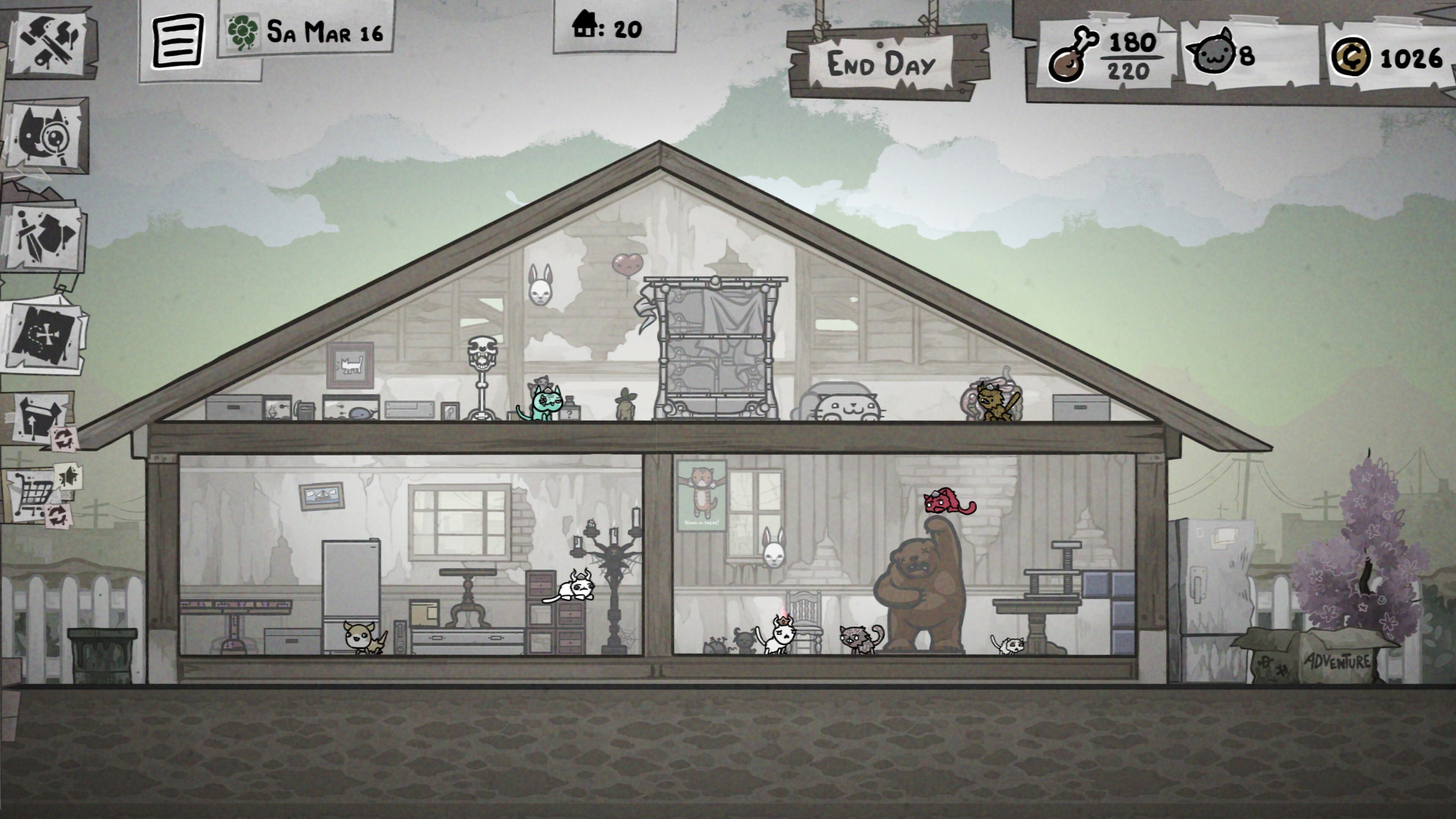
Speaking of unlocking, this is another big feature of this game. You have different NPCs that you meet early on, each one providing further bonuses and tips if you give them your cats. For example, the mad scientist (of course there’s a mad scientist) gives you unique cursed items you need to take into your adventures as sidequests; the stereotypical gay dude wants babies because him and his wife can’t have offspring and gives you all kinds of relationship advice which unlocks to additional features; there’s another guy who has a grandma (nanny) that doesn’t hear well and wants to sell you weird furniture; a bitter psycho that seems to work for PetSmart, and more.
But wait, I didn’t really talk about the actual turn-based RPG part of the game, which is the main thing!
The main game consists of taking turns with your cats on a grid that has different environmental effects (lava, water, flowers that heal you, garbage bags you can destroy, grass that can catch fire and spread, etc.) and attacking the enemies with your unique abilities. Some of those are straightforward (you shoot an arrow over a range, or swat with your paws), some are magical (a fireball or a lightning bolt), some are weapons (shotguns, broken glass, rocks), etc. Your cats, depending on the class and unique skills you pick up along the levels, also have other unique abilities like healing other cats, raising the dead, backstabbing, charming enemies, and more. Your goal is pretty simple (For once! Something simple in this game!): clear the level of enemies.
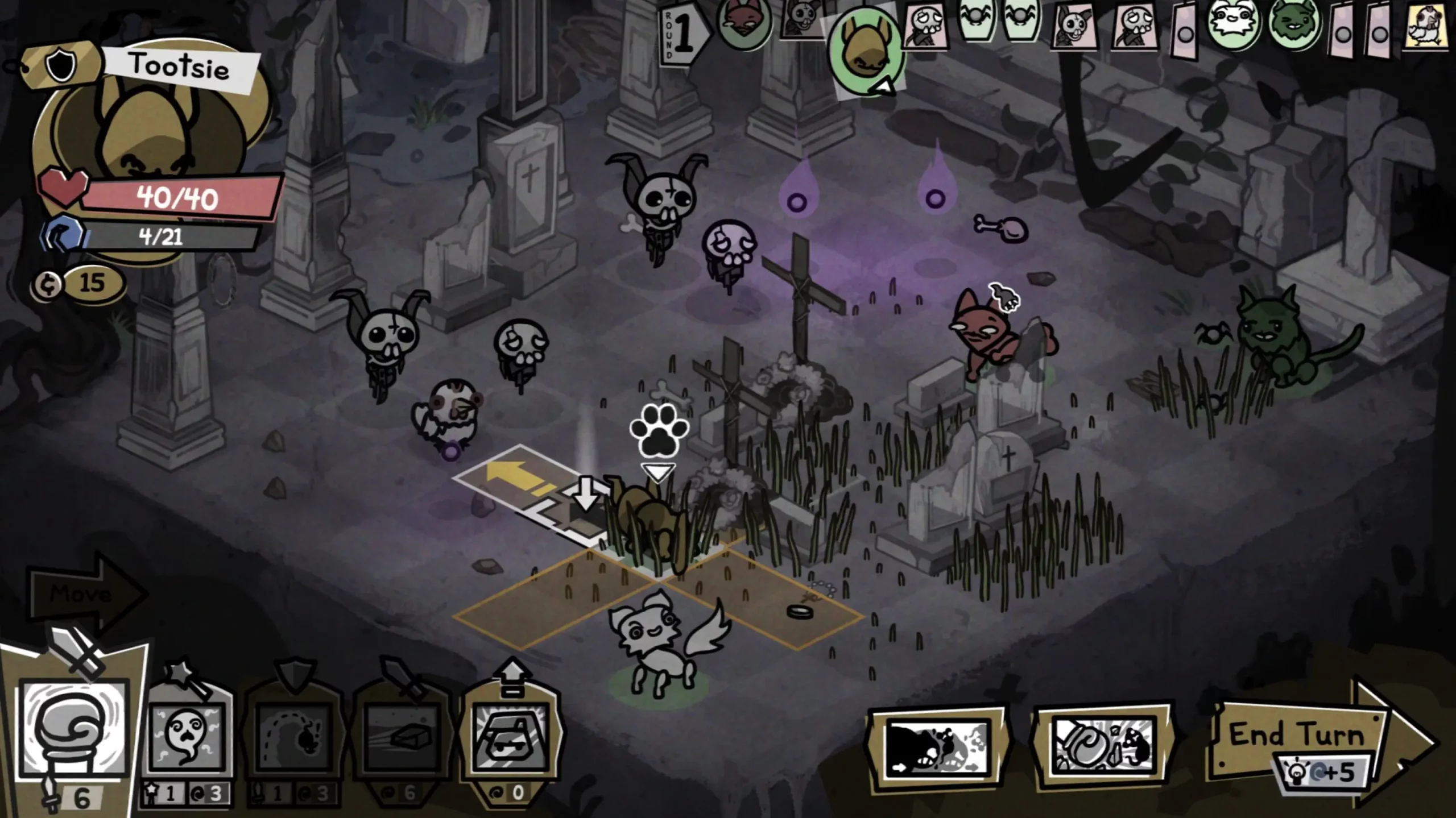
The enemies have unique abilities of their own. Some are plain dumb, while others are completely disastrous (one of the bosses can possess one of your cats, which then turns on you. I hate this guy). Each level brings a bunch of new enemies, environmental hazards, and items that help you along - these are reshuffled each adventure. The game adjusts to difficulty levels, so you won’t see all the enemies a certain level has until later, and then some enemies can be “elite” status, creating even more havoc.
At the start I didn’t think I could make it just with four cats, but as I progressed I unlocked abilities that made them real badasses; it helps that you can heal cats and even bring them back if they die, while you can recruit various other creatures to help along the way.
I’m looking at the level list, my achievements list on Steam, and the wiki for the game, and I’m realizing that at this point I’m not even half done. It’s a game I picked up last year after finishing Hades 2, and I’ve been playing often. It’s a game that’s easy enough to pick up at any point but hard to put down. It has a lot of content (if this post is any indication) and I highly recommend it if you’re into cats, rogue-like turn-based dungeon crawlers tactical games, dirty humor… look. Just get it. It usually hovers over the $20 range, and it’s worth every penny. Now if you excuse me, I have a mini boss to deal with that’s giving me a hard time.
Oh yes, I think I’m going to enjoy this game very much.
Subnautica: A Great Game That Deserves a Better Ending
Some games are over before the official ending(s). Sometimes it feels like the developers ran out of ideas or perhaps they never planned to go byond a certain point, but whatever it is, it feels cheap: You reach a certain point and there are endless hordes of enemies who just keep coming to make things harder, or a final boss who has an unfair advantage for no real reason, or the end of the story seems rushed and out of nowhere. It’s particularly disappointing when it happens to a good game, one that you’ve enjoyed for weeks and spent time on. For me, that happens in Subnautica.
Before I go on, two disclaimers:
OK then! Let’s dive in.
If you follow the plot, you arrive at the Lava Lakes (the last and deepest biome in the game) in search of the Primary Containment Facility. This is where you find the Sea Emperor Leviathan, which, as you learned, is connected to the cure for the disease that plagues you and the rest of the planet.
You find the Sea Emperor in this facility soon enough, as well as several portals that can transport you instantly to several locations in the world. It’s a sort of fast travel, something that Subnautica doesn’t have besides one very special connection that happens early on between the two islands. To me, these portals were the first warning sign that the developers wanted to hurry things up and go home.
These portals (which can be hard to find and are part of the exploration part of the game) cannot be activated up to this point, at the end. Instead, you have to use whatever means of transport you have, which is usually the Cyclops at this point. It is a huge sub, acting as your portal base; it’s loud and slow, much like an alarm bell screaming your location to any nearby scary leviathan on the way and inviting them to take a bite. Sure, you can choose to take the fast and sneaky Seamoth, but if one of those guys catches you along the way, it can merely crush it in one bite and grant you a jump scare that will make you yelp loud enough that your partner comes to check on you.
It’s one of those core elements of the game that you learn to be better at. Going from point A to point B is usually risky, no matter how you do it. It’s also why the game is frustrating in a way: you almost always miss one important piece of something you need to craft the next important gizmo, which means you have to go back into the darkness to hunt for precious shiny stuff.
The portals basically eliminate this problem. They send you to different locations around the world that either have what you need or are close enough to it. Suddenly, after 95% of the game behind you, there’s finally fast travel. And you need this fast travel, because the next part is pretty much grocery shopping for Enzyme 42, AKA the cure.
To craft it, you need components from the four corners of the world, conveniently located at the destinations of these portals. And when I say convenient, I mean literally as soon as you exit the tunnel where the portal is - It’s right there in front of your face. So my question is, why bother at all? What’s the point of getting these components if traveling to them takes mere seconds?
There’s another phase of more tedious grocery shopping that has started to feel like a struggle for purpose. At some point I even wanted to put the game away and be doen with it. The Neptune Escape Rocket.
This one is also a bit my fault: I didn’t have to wait until this point in the game to start building the rocket; I could have started much earlier. The game prevents you from launching the rocket until you get the cure, so building the rocket alongside the story, as you get access to more minerals, makes sense - and in retrospect, this is what I would recommend to people new to the game. Since I knew the rocket meant the end of the game, I left it alone until I had found the cure. That was a mistake.
If getting the ingredients for the cure was an annoyance, building the rocket felt like a chore. Each of the five parts of this big rocket requires unique materials found in specific biomes, and while, yes, I had the portals at this point, the game does not tell you which components you need for each part until you build the one before it.
This means that you go grocery shopping five times, each time for the next part once you learn what you need. This is the only blueprint in the game that is handled this way. For some reason, with the rocket, you just “know” how to build each part after you build the part before it, which effectively prevents you from planning and gathering everything you need at one go. Why? What’s the point of this? And how do you know to just keep building this Rocket?
Luckily for me, there’s the wiki that I used in my links here. It gave me the list of ingredients for each part. I mentioned it in my previous post about this game - a little cheating here and there improves the gaming experience.
The way the rocket building is handled goes against what you’ve learned playing Subnatica up to this point - that is, you get blueprints is as part of exploration and dealing with your fears. I couldn’t find any in-game reference that explains the rocket is different. In other words, you can spend hours going crazy trying to find the next parts of the rocket’s blueprints, which is exactly what the game has trained you to do up to this point, before you finally give up and just build the first part. In my opinion, this is lazy end-game design.
Lastly, there’s the story. This is more forgivable and can pass as a cliche or a plot hole, but it’s worth pointing out because the story thus far was interesting. It’s the fact that the adult Sea Emperor dies at the end game, mere minutes once you get the cure. This is bullcrap.
The parent (I think they are supposed to be sexless creatures in this game, but they gave the Sea Emperor a woman’s voice, and it lays eggs and needs them to hatch - they make it pretty obvious, contradicting themselves, but moving on) has been living in captivity, in that aquarium you find, for thousands of years. It got whatever it needs to survive all this time, just for the chance that one day someone will show up and concoct the enzyme that would hatch its eggs. Then, once the “younglings” hatch, the parent claims that it’s time for it to die, and basically does exactly that. Why can’t it live another thousand years? Or, more logically, why can’t it be dead already when you get there (the game tells you previous attempts to grow these creatures in captivity didn’t work), so you have to figure out how to hatch the eggs yourself? I don’t know. This whole part of the game just made me roll my eyes with the Lion King’s “circle of life” stuck on repeat in my head.
There are games that make me annoyed enough to just quit because of things like that. But with Subnautica, I just wanted to see if the ending was as bad as I thought. And yeah, in my opinion, it pretty much was.
As I said though, Subnautica is still awesome. I still love it enough to jump right into Below-Zero. It feels like it could use a message from the developers when you meet the Sea Emperor: “Congrats, you pretty much finished the game. The next parts are grocery shopping and a cliche ending. Continue at your own risk,” or something of the sort.
Playing Subnautica again: why cheating sometimes make things better
I mentioned I picked up Subnautica again, and it’s more fun than I remember it was my last time with it. Why? Because I’m kind of cheating. Hang on, hang on, hear me out….
Subnautica is not an easy game for the easily distracted. For those of us who constantly forget what we were doing because there’s a new shiny thing to focus on, Subnautica can be brutal. A large part of it is survival and crafting, which means my internal monologue goes something like this: “I need some copper for the… oh wait, if I get more silver I can craft the wiring kit for that torpedo, but I need aerogel… what do I need for aerogel? Oh, gel sacks, right, OK, where’s my Seamoth, ha, I forgot I docked it outside instead of the moonpool… oh crap oxygen! swim up! up up up up…! Whew! Wait, where am I? Where’s the damn Seamoth? Ah! Here you are… good, now what was I doing? Silver? Or was it gold? I wanted gold for the CPU so I can craft… oh right! I need copper.”
The game’s a lot of fun, and it rewards you for exploring, but when your brain constantly works like the above, you tend to miss a lot. This is why I started looking online for things like where to find X, and watching a few helpful YouTube videos. I also learned which plants I can grow around my base so I can craft what I need more easily, instead of running around and forgetting what I’m looking for. Because I played about 2/3 of the game before, I know the basic plot and what’s going on, so I’m taking my time now preparing for each new horrifying level and enjoying building my base and putting more details into it.
Another very helpful aspect of searching for answers online is finding the parts for blueprints I need. The game gives you recipes, or blueprints, for different tools. Some of those are required to get to a certain point; otherwise, you can’t progress. Certain materials are not available to you until later in the game as part of how it’s built, which makes sense, but it means I can tell when something fairly basic is missing. In order to find blueprints, you need to scan certain wrecks and parts in the game, and you need to find where these parts are. They tend to be in certain areas, however, where exactly in those areas is random.
For example, I needed a propulsion cannon to push crates that blocked my way to a place I needed to go. I knew I needed to go there because I was at a point in the game where this is indicated by the audio logs I picked up, and also, I played this part before. I was looking at the ingredients needed for the cannon and noticed they’re very basic, the sort of things you get really early on. However, I only had one part of the cannon scanned; in order to get the full blueprint, I needed to find one more part, which I never did. Because I knew I needed this cannon at this point, I looked online to see where this part is located. It still took a bit of time, as some YouTube videos are more helpful than others, but I was able to find it because I knew exactly where to look - and even then, it was hiding in a tough spot to reach (again, not by design).
If you ask me, the randomness of where these parts can be a bit of a design flaw, especially when something is trivial to the game, which is exactly why this sort of “cheating” is justified. I got what I needed, and the game flowed exactly as it was designed, with everything else clicking into place. But not all cheating I do is the “good kind” like the above; some of it is cheesy. Subnautica is a scary game, the sort of game that freaks you out with the unknown. And it’s good at freaking you out, believe you me.
Because I played the game before and had already seen most (maybe even all) enemies, I took a peek at some fighting strategy videos against the hardest creatures to take some of the sting out of the fear. I wanted to be ready and enjoy without being scared all the time, ok? Being a bit scared is enough. It also doesn’t help that the game only has exactly one save game slot per game either, so if you really mess up somehow, you’re screwed. Fortunately, that doesn’t happen too often… but it can. Which makes me worry. Which takes away some of the fun element. So yeah, some fear control goes a long way. Exploring is still fun and stressful in the right amount that pulls me back.
See? Sometimes a bit of corner-cutting helps.
A good weekend
Last weekend was good. I came to a realization not too long ago that most of my weekends are good, which is a good thing in itself, but I wanted to ramble a little about why.
My sleeping issues (I should coin the term somehow. “My Sleeping Issues” sounds like a terrible album name stuck on repeat at this point) meant that I woke up at 4, walked around for a bit, and went back to bed around 6. This pattern has been going on since last Thursday, when I pushed myself to be in bed at around 23:00. Seems like I sleep 5-6 hours no matter what I do, so if I go to sleep earlier, I wake up earlier without enough sleep. The good part? Going to bed around 6 again means I’m not a complete zombie the whole first half of the day, which definitely played a role here.
First off, there was a lot of Subnautica. With Part 2 out in early access, I saw Subnautica: Below Zero was on sale on Humble Bundle and snatched it. I never finished the first Subnautica (it was too scary, and yes, I need to get this post over to the new blog moved!), and I wanted to try again. Man, Subnautica is a treat. It was easy to get hooked again. This time around, I watched plenty of YouTube videos to help me out with tips, and building my underwater base was fun in a relaxing kind of way. There’s something about being able to organize a stressful situation that doesn’t let you breathe (literally in this game) into something safe that makes sense to you. And, yes, that’s also a metaphor.
I mentioned before I want to make some video content for gaming, but it’s not easy. Or rather, it’s a lot. I am no stranger to OBS Studio, but I had to re-learn to do a couple of things, and even then, going back and watching an hour or more of content and starting editing takes a lot of time. It’s a serious commitment. I haven’t given up on the idea, but I might change it around a bit toward a mix of writing and video content. I’m not sure yet. There are too many good games out there, and I don’t think there are enough places reviewing them from a personal perspective (by the way, let me introduce you to Laura Michet’s blog. She is a game writer/narrative designer, and she writes often).
Then I had a nice hangout with my partner, who works as an EMT. They are awesome in general (obviously I think so), and they recently got themselves a car, and driving in Manhattan is… well, let’s just say parking is one tough SOB boss. Imagine working a 9-hour shift in an ambulance, driving around (on a weekend, because during the week they’re busy with their other job), just to drive another two hours, the last hour and a half(!) of it is in order to find parking. They pretty much showed up just to crash and fall asleep, but then the next day, we went to the Farmer’s market together and drove around and walked the parks of upper Manhattan. It’s a sort of buffer, a break that makes my brain slow down a bit and appreciate my life outside of work and tech.
Which means that when I got back to my /own/ tech on Sunday, I was refreshed and full of energy. This weekend I installed Harper on my Linux desktop. Working through it but especially writing the post about it requires geek brain energy, which I just don’t have during the week. I really enjoy these projects; I learn more about stuff I’m passionate about, and it’s very rewarding.
I also wrote a lot in my journal, which I’m reorganizing, and it made me realize that, hey, I write a lot. Between my posts, emails to other bloggers, journaling, and experimenting with TiddlyWiki, there’s a lot of keyboard typing going on. This, as usual, makes me appreciate Emacs and org-mode, which has its own dedicated category. But that’s what happens when you can customize everything about a tool you use all the time: it’s a game in itself.
And now, with coffee done and this draft more or less complete, it’s time to get in the shower and quickly get some groceries before the work day gets the chance to kick my ass back into gear.
This is a better video than I expected. The main idea is nothing new, but the video games he mentions are perfect examples: I’m also looking for my next game after Hades 2, and I think thanks for this video, I found it. It’s about cats, how can you go wrong?
Diablo IV (2023) - ★

Nope. Nah ah. I tried this game twice, and it failed twice. The first time I didn’t enjoy it. It was too much clicking with little to show for it. No strategy, no method to the madness. I looked for light entertainment, and I thought I found it in this game, just to put it aside after an hour or so of playing.
The second time, about a week ago, I decided ot dust it off and try again. It was the same disappointing lack of wits, only topped with annoying additional in-game purchase requests for all kinds of nonsense, and a complete lack of any challenge. At all. None.
As I was watching the second boss in the game getting destroyed by an army of skeletons that I’m not even sure why I was able to resurrect so easily, looking at messages on my phone, I got pissed. A game should be interactive. What I saw in front of me was a flashy animation that didn’t need me to move a finger. No challenge. No brains. No fun.
At least I can thank Diablo for getting me back into reviewing games just to express my frustration.
Managed to get Diablo 4 to install and run on my Linux Desktop running Kubuntu. It was actually quite easy with Bottles, using a Proton launcher made especially for that game. I’m not sure exactly what goes into creating those launchers, but glad it works.
Cyber Knights: Flashpoint (2025) - ★★★★½
It’s been a while since I talked about a game here, and Cyber Knights: Flashpoint is a good reason to get back in the habit. Hopefully.
There is a lot going on in this game and a lot to like. It’s a bit hard to compare it to other games, but I can start by saying it’s a sophisticated X-Com turn-based tactic squad game with a deep story and base management on the next level. But it’s much more than that. Take each system you know from X-Com and bring it up to the next level, and then you’ll start to get the idea.
You’re in charge of a group of mercenaries in a futuristic, dystopian Cyberpunk Boston. Your goal is to pick up missions from different contacts and get paid so you can pay the bills. This game being story-focused, there are main-story missions, and there are characters with interesting stories that develop as the game goes on, depending on the choices you make.
In combat, it’s a detailed turn-based game with many mechanics determining what you can do and how. These mechanics are based on Cyberpunk the TRPG (the latest version is Cyberpunk Red), so there’s a lot to take in. Action points determine how far you can move and what actions you can do, but certain kinds of movements (sneaking) are slower, and the overall amount is affected by the character’s reaction attribute. Likewise, the character’s strength affects the amount of recoil after they shoot (to stabilize the weapon), which in turn affects the percentage to hit, as well as weapon modifications (yep, they have those), and certain traits the character has, which are special skills, separate from attributes. The game engine in combat is improved from X-Com, too: grenades can bounce off surfaces, the angle your character is facing affects the amount of cover they have, and enemies have a radius of seeing and hearing you, depending on how stealthy and quiet you are. And there’s much more (did I forget to mention there are classes in this game, and the ability to multi-class? Oh well, I need to post this at some point).
The combat might be the main highlight, but for me, the developing story is just as fun. Your characters talk to each other in on-screen dialog, and you get to choose the answers to certain questions. They form relationships with each other, which affect the gameplay as well, depending on the missions you play. Each character is unique and brings their own additional missions, choices, enemies, and allies. They have their own general background where, as they talk about their past with the others, you get to choose what exactly happened to them, where, and when. You can also change characters’ looks and add notes about them as well.
Meanwhile, the story has the depths and details of a rich TRPG campaign, because Tresebrothers, the makers of the game, have been playing a homebrew version of the aforementioned Cyberpunk Red for over a decade. Many choices you make count, and some are irreversible. You need to keep track of the complicated political landscape as different employers try to con you while the guy who operates on you for cyber implants (yet another thing I didn’t get into - yes, you have those) might have a brother who got lost somewhere and will ask you to help in exchange of a favor, because favors are an important additional currency in this game. Loyalty is a factor, and an employee who likes you is more likely to pay you more for your missions and give you special equipment - but at the cost of others disliking you, and some squad members will refuse to go on missions for someone they hate, for example. All of this is managed by the game’s “DM” which builds missions and stories for you as the game goes. It’s a bit like Rimworld’s storyteller, if you’re familiar.
There’s still more to this game I haven’t talked about. The base building is similar to X-Com, but yet again, on the next level. You need to manage power and cooling, among other things, to be able to build certain facilities, which open up even more possibilities. For example, in my still early game, it’s indicated I could build certain weapons and mods in my own base instead of trading in the underworld, but I don’t have the right place for that yet. My “face,” the squadmate who is a special class who takes care of the missions, can have their own operation room, which might bring in different kinds of missions and options that I don’t know about yet. Even the way the power is laid out is not as simple as just running wires; some rooms get more power than others, etc.
Oh, and did I tell you there’s hacking too, which is its own form of a minigame… OK, I’ve got to stop somewhere.
This game makes me miss my own DnD games and makes me want to pick up Cyberpunk Red (I got the rulebook a year ago or so) and try to play some. There are few games that are this detailed and complex, and none that I know that combine it all with tactics, base building, and of course, the beautiful dystopian cyberpunk theme. If you’re into RPGS/TRPG, or if you liked Cyberpunk 2077 and want some more of that world, or if you’re thirsty for a good X-Com-like game, or if you like complex systems and want something challenging, or all of the above… check this game out. It’s very much worth it at its non-premium price tag.
I’m finding it hard to enjoy video games recently. They all feel… the same. I keep playing World of Warships (that’s more of an addiction) and Helldivers here and there, but I want something with a story, and even though there are a couple of options, I can’t seem to be interested in anything in particular.