
The woes of flexibility vs. structure
I paused my Trainwell subscription, my exercise app. I didn’t give up my exercise routine if that’s what you’re wondering, though it has suffered in the last couple of weeks. As I explained to my excellent coach on the app, there were two reasons for that.
The more immediate and simple one is everything going around me: I’m moving out, and I am now tasked with working both in my new position and my old position, which I left a few months back since there’s no one else who can do it at this point. These two things with an additional few recent stressful events cause my insomnia to spike, and I often wake up after 4-5 hours of sleep, which messes up my ability to work even further, putting me in a vicious cycle of trying to make up lost for time and energy.
The longer, more complicated reason is the lack of flexibility. Trainwell is an exercise app with a limited number of exercises and a busy coach who can’t remember and adjust everything about you. Things like meditation and even running are not handled well by the app, at least not yet, and I have to look elsewhere for those. Since Trailwell costs $100 a month, I expect more from it, and it can’t deliver.
I have very limited space in the apartment to exercise, so some exercises and stretches don’t work for me. On top of that, the app works by introducing new cycles each couple of weeks, and these come filled with mostly new exercises that I haven’t done in the previous cycle. I tried to navigate away from exercises I didn’t want and keep the ones I did with limited success. New cycles usually mean a period of adjustment and learning, and I realized that this is starting to damage my routine. Instead of improving what I do slowly, I’m starting something new.
Speaking of routine, I’m now at a point where I want to exercise without being forced into it. It’s a good part of my day, with the key (that I keep forgetting) of doing just a little at a time and doing more after I start if I can and have the time. Doing a short 10-minute daily exercise is always better than not doing anything because I’m intimidated by an intense 30 minutes of weight lifting. Yes, I can adjust my exercises on the run and work with my coach, but that in itself is cumbersome, and I don’t always want to explain why I did one thing instead of the other every time. I asked myself: if I’m already adjusting and switching exercises to fit my needs, then what use is the app in guiding me anymore? And the last couple of weeks were based on adjustments to my crazy schedule.
So, I decided to return to my old workout sheet with the addition of a few exercises I’ve learned in the last months. Here’s a portion of it:
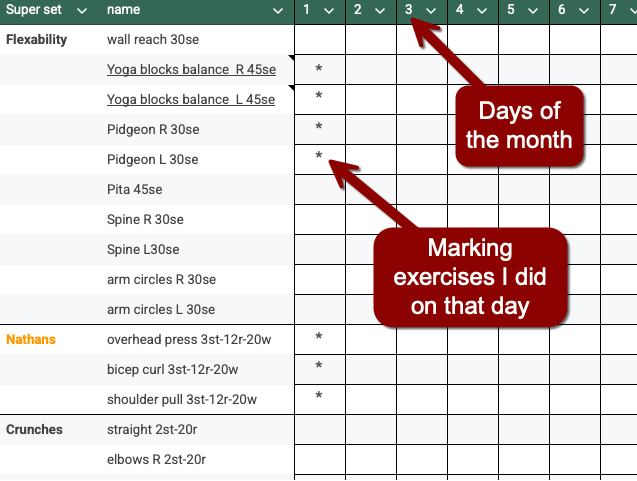
However, I quickly learned that a simple spreadsheet is problematic. I want to measure daily exercises (in the image, you see the page for February. I have a sheet for January and will keep going for a year), so I’m using the Y axis for the exercise names. I wrote the specifications for reps/sets/weights next to the exercise’s name (it will take too much room to specify for each day), but it is an issue if I want to change the number of sets/reps I’m doing on the fly. For example, if I join pull-ups and chair dips, I probably want to lower the number of push-ups I do that day since they overlap the same muscle groups. Another issue is that different exercises may have different data altogether - for example, running records speed and distance, not weight and sets. Yet another problem is that the list of exercises becomes longer, and finding the exercise I want to do on a certain day and joining it with others becomes confusing, so I need to start color-code those, which means I need to be more picky about which colors I use when I go up in sets/reps during the week…
you get the idea. It just doesn’t cut it, and I have issues already.
Meanwhile, I have my Apple Watch, which I’m trying to utilize for all of this. It comes with Workouts, but those are basic pre-determined activities that don’t allow me to add weight or follow sets conveniently if I break for rest in between. There are other apps out there I could use, but then I run into the same problem I have with Trainwell and flexibility: if the app doesn’t have a certain workout, it’s annoying to use it just for some things and not everything.
I don’t like the lack of structure in my exercises, which is why I need the table on one hand, but on the other hand, it’s not flexible enough to do what I need. It’s starting to sound like “I’m holding it wrong”, not an app or a sheet problem, if you get my meaning.
Still, the exercises I end up doing are good and fit my routine better than the ones I followed on the app, as in. At least I’m doing something. I need to figure this out.
According to my Apple Watch, the last time I slept more than 5 hours or so was Monday. Last week was similar. At work, I’m required to do two roles at once again, and it’s piling up on top of the apartment hunt. I need a vacation when this is over.
I updated my photo page plug-in and didn’t realize I had to toggle a new option. Now, it shows the photos it’s supposed to show.

Finished reading: Open Season by C. J. Box 📚 I couldn’t put it down at the end. The problem with suspense books is that they are suspenseful. It’s a good story, I wouldn’t be surprised if it comes out as a movie.
We found a good place, liked it, and were getting all our documentation in order, but then someone else applied and pulled it from underneath our feet 😡
NYC apartments are hard.
I’ve been enjoying Open Season by C. J. Box 📚. It’s a well-written (many details) country detective-suspense read. I’m at about 70%, but I figured out what’s going on already at 50% or so. Still, it’s a fun read. I enjoy being in Joe’s head, and I have quite a few life references highlighted.
About what happened on micro.blog...
Does anyone like hospitals?
You’re usually there when something bad happens. Even if it’s good, it’s wrapped in worries. Other people lie in beds in vurnabale states, all wearing the same thing. There’s this hospital smell and the silence you don’t like, but it’s better than the alternative. I don’t think it’s ever a good thing.
Yesterday was my second hospital visit this month. Everything’s fine, which may be why I feel I should write something while I come up to get air.
Micro.blog was swept by an emotional storm that surprised me. For a while, I sat there shaking my head and reading. Eventually, everything just became a bunch of loud virtual yelling that stopped making sense, so I went away to deal with my own shit, of which I have had plenty in the last few weeks. Seeing that it quieted down a bit, I think maybe it’s time to bring up a couple of general tips I found. I don’t think it can do any harm, but I can’t be sure. Someone will find a way, probably.
First, 300 characters or so is not enough to discuss complicated topics. It’s not enough to discuss anything, really, but certainly not the kind of subject I’ve seen floating around this week. Manue helped me realize this was the main part of the problem. We exchanged a few emails since, and I’m with him on this topic: if you want to say something, write it down in length, from one person to another. Don’t make a stage out of it. Another good piece that started showing on my feed (I don’t remember where I saw it first, so I can’t give credit) was “how to comment on social media,” which you should read with your sarcasm hat on, and hopefully get a laugh or two out of as well as a cringe.
I do use social media often - this is how most of you found this post. But I usually use it for short summaries of longer discussions that link back here. These days, even short questions that fit fully into a post over Mastodon come from this blog. This is one of the core things about Micro.blog. This also brings me to the next important point. Create the content on your own website, and then put it on someone else’s broadcasting machine. You don’t know what they’d do with it, and you can trust them to save it for you. Things get lost, twisted, grow teeth and bite you in the ass and then run away. Own what you say, both as a person and as a writer. This allows you to make mistakes, which you also own, and then the resolution of these mistakes is also yours.
Eventually, things will get out of hand. You’ll get upset and want to plunk that loudspeaker off the hook on the wall and give everyone a piece of your mind. But you know you shouldn’t. As soon as you feel the first “WHAP!” of someone else’s whip on social media, you have a chance to be better. Stop the lashing. Take a break. Relax. If you have your corner on the web, there’s no need to explain anything to anyone. You will respond (if at all) when you damn feel like it. And when you do, you will do it on your terms, like a conversationalist, not like a raging bull.
And this will also fail eventually. If it’s too late and the mob with the pitchforks is at your door, there are some well-tested ways to resolve disputes. (this is just one place I found with a good summary; there are many others). In short, get a mediator or an abbreviator (judge).
This will also eventually fail, and you will lash out. It’s OK. You are huamn too, a flawed mess like the rest of us. Don’t respond, and don’t defend yourself. It’s wasted energy: at this point, you’re already a monster (or fascist, or racist, or whatever the kids use these days) to the mob, and it doesn’t matter what you do. Apologize to those you care to apologize to and own your mistake (see above). Be quick about it, be polite and to the point, and move the fuck on. You have better things to do.
Who am I to be telling you these things? No one. I’m not better than anyone else. I’m just another meat bag, to quote one AI bot in a popular weather app. And this is my blog, so if you don’t like it, don’t waste your time and go somewhere else you’d enjoy more.
Now, where was I? Hospitals? Yeesh, I was yapping too long, and I barely scratched the surface of everything else going on in my life that I want to blog about. But it’s also 4 a.m. (at least when I write the draft), and I should get back to bed to get some more sleep.
If you want to say something about this, go ahead. But if you want to talk about this, email me.
A couple of years ago, I froze my credit reports with the three major credit companies in the US. At the time, I had a different phone number. Now that I’m looking to move into an apartment, I cannot log into my old accounts to lift the freeze. I have to call them instead.
It’s not going well.
After yesterday’s issues, today I split my now.org into four different files: personal projects, work projects, work meetings, and blog projects.
Thinking about how to organize the projects in those, I rediscovered org-sort. I think I’m on to something.
More problems with my projects and meetings in org-mode
In my capture templates, I now use prepend, which works well and puts my captured header at the top of now.org, which is what I want. The problem is that I barely use the meeting capture template I’ve made. I refile from my calendar file 95% of the time, and Refile places headers at the bottom of now.org bottom. The results: new projects are at the top, and new meetings are at the bottom. Chaos.
I know I can reverse how Refile works, but I’m not sure I want this to work globally. I can start hacking things and write functions to refile meetings the way I want, but I’m starting to think my problem is bigger than that.
See, the above is just the latest issue in the last week. When I was sorting through tasks on now.org I saw a bunch of TODOs that were tied to a project at one point on the project level; that is, TODOs are filed among the ACTIVE project level, floating out of their parent projects, and as some of those get old I have no idea what projects they were used to be a part of. Why did that happen and why, I don’t know.
On top of that, I just had the issue yesterday where some of the headers lost their “**” at the start of the header, non-headers.
I can’t trust my now.org like this. I’m frustrated, and I just want to throw every single project into its own file at this point, just because of this mess.
I need to calm down get back to the basics and define my main workflows (meetings vs projects vs quick tasks etc.)