
Why I end up using Photoshop over GIMP
Adobe sucks, so why do I keep getting back to Photoshop?
I like GIMP. It’s an amazing piece of free software. It comes with tools like Intelligent Scissors that allow you to easily draw a selection around your subject, much like the Quick Selection tool in Photoshop. GIMP also has Foreground Select, which roughly compares to Object Selection in Photoshop. Even the useful Content-Aware fill in Photoshop exists as a plugin in GIMP.
The problem is that all of these come with a learning gap.
Intelligent Scissors only works with good contrast, and even then, the official documentation suggests using masking tools. You need to have a good concept of these two terms first. The Foreground Select tool is a confusing multi-step process that’s hard to follow and requires me to follow a video explanation somewhere else several times. The Content-Aware plugin for GIMP is an abandoned project that hasn’t been updated to work with the more recent versions of the software, and its installation documentation on Linux requires more research on installing old libraries and Python.
Meanwhile, Photoshop’s help is very effective: short videos whenever you hover over a tool to tell you what it does, complete with the keyboard shortcut if you have one set up. There are video tutorials from the company, not to mention many professional folks who create tutorials. GIMP has one or two people worth following on YouTube, which couldn’t supply the help I needed. It’s a complaint I had before about Darktable, which eventually got me to switch to Lightroom.
As a technical writer who needs to explain tech stuff to people daily, I believe documentation is one of the areas free software suffers from the most. There’s usually a small crew of basement geniuses who write out an amazing tool, but their documentation amounts to technical jargon on Github which means nothing to others. These people write tools for themselves, not for others to use.
I understand the problem. A person who writes a program for free doesn’t have the time and resources (or the experience necessarily) to also write instructions. The same is true at my job: the techies tech, the communicators communicate. The importance of the latter is not often obvious. But if you invent a time machine, and you’re the only person who knows how to use it, does it really matter? If a tree falls in the forest…
And yet there would be that person who would read this post and think help is just a Google Duck Duck Go search away. They will find five or six results and link them to this post, suggesting help is just a quick search away. It is not, not for me. Think about it: what is more likely, that I searched and still couldn’t figure it out, or that I didn’t bother to search to begin with?
The gap exists. Those in the know are so used to jumping over it they don’t even notice it’s there anymore. I know because I do the same thing to others all the time.
I’m grumpy and tired, and when I sit down to work on something, I don’t always want to invest a couple of days’ worth of research just to get a certain thing to work. When it has to do with free software, there are a few places things work, and that’s because there’s a community around those who can explain and document things to others. Take Emacs for example. When I started, it was this video by an ordinary guy who explained what the software does in an ordinary way that got me hooked. This dude spoke a language I could understand.
This is why Adobe wins me over time and time again. Their software is good but far from amazing. The company, as an entity, is shit. The privacy factor, which I care for, does not exist. But I can learn it and use it without investing a week’s worth of research on old posts in forums, Github, and Linux chat rooms.

Started reading: The Last Girl Scout by Natalie Ironside 📚 Decided to get this after reading a sample. Good, solid writing and an interesting story so far.
Yesterday I walked into the park and sat on a tree trunk I found years ago. I sat on it as I did back then, letting my mind drift, surrounded by the sound of the leaves rustling in the wind, enjoying my lunch.
The picture 📷 is from nearby, turned into a watercolor painting with AI and Photoshop.

It’s over 90 with humidity over 60% for the last couple of days and I stayed mostly indoors. Today, there’s a nice breeze coming through, and it seems like it’s going to be the best day of the week. Tried to get myself running but I don’t have it in me. A walk then, with some pictures.

Blogging about blogging is writing about yourself
When Brandon wrote that he blogs about blogging too much, I bookmarked the post with my Micro.blog service so I don’t forget to reply and went back to read through my RSS list. The next day, Kevin wrote his response, and I wanted to get back to it, but I was in the middle of writing a different post. When I finally got to it Friday, I felt I should contact him before publishing it.
The more I write, the more ideas I have, the more I want to write, the better it all feels. If I didn’t know better, I’d say it’s a form of addiction. Maybe it is, just not a bad one. Kind of like coffee in the morning. Oh, I should write about this too.
In a nutshell, this is pretty much my writing process these days. There’s always something to write, a quick note to share, or another post to reply to. But let’s get back to Brandon.
I’ve been following Brandon for a while, and I suspect his worries are affected by a bit of harsh self-judgment. He is (and I’m writing this with respect and care) a bit hard on himself at times. You can tell because he says so right at the start: “I didn’t realize how much of a problem it was.” So, for Brandon, this is a Problem. But is it? We all get self-conscious sometimes: I just deleted my first three paragraphs because of similar reasons, but I’m also trying to get the point across.
According to Kevin, blogging about blogging is not really an issue. But that’s Kevin. The guy writes with confidence and projects confidence. When someone criticized him lately for being narcissistic for creating a randomized watch selection mechanism in his blog for the world to see, he told them to get back under their bridge. Kevin will tell you what he thinks because that’s why you’re reading his blog. I agree.
And then there is Jack and his blogs (Jack, if you’re reading this, this might be a good name for another blog to write about the other ones you have 😉). The man goes back and forth between platforms every week. Jack’s not really hard on himself (though I get the feeling this is starting to drain him), nor is he confident about how much he writes about his blogs. It’s just something he does. Jack’s reaction would probably be a picture of himself shrugging - in black and white, of course.
I know these three bloggers as my buddies because, among other things, they blog about blogging.
Writing is deeply personal, so writing about writing (or blogging about blogging) is writing about who you are. It’s a topic any blogger would blog about at one point or another because that’s what bloggers do. They blog.
Since blogging is a hobby, I enjoy reading about other bloggers and how they write because I’m a blogger, as Kevin said. I understand Brandon might feel self-conscious, but that self-consciousness is why I like his blog: that’s him.
So, Brandon, please feel free to keep writing about blogging!
And here’s an idea, something I used to do on my wiki: a log, much like version release notes. That’s where I wrote the more technical details of what’s going on for those interested, and those who don’t care just stay out of it. These days I use this less and include things here, though I could create a category for it if I wrote about it enough… oh, here’s another idea to explore, let me add this to the list.
Rethinking & Organizing my life with org-mode (part 4)
Welcome to part four of my rethinking and organizing with org-mode.
In the last part, I rediscovered org-achieve and the option to archive past events. Turns out this works well. Since the archive is an org-mode file, I can add options (like making it present pictures) and give it a user-friendly name. Here’s an example from an event I just blogged about. Looks pretty good, no?
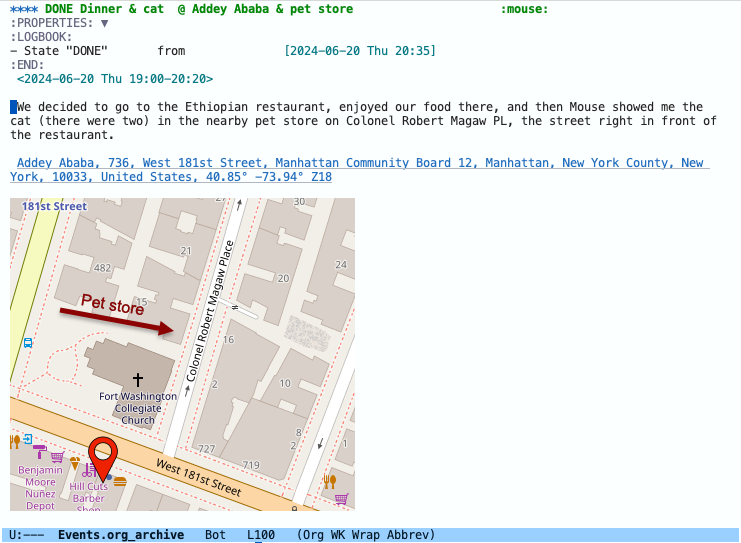
The map is by the OSM package, and the screen capture with annotation is with Snaggit, which I use for work. You see it because I included #+STARTUP: inlineimages at the top of the file. The date breakdown is an automatic org-mode archive option I discussed last time. I use the tags to include people in events and at this point, also to note that I took photos (I don’t want to attach those because this will quickly eat up space - though I could just link somewhere else where I store them… 🤔)
Not bad. I like.
Mouse introduced me to their friend and a guard at a local pet store last night. 📷 I’ve walked these streets a hundred times, but I don’t see the things they do. It’s like discovering a hidden world in the world I know each time.

How not to quit Google
One does not simply quit Google - If you’re not a techie. Sure, you can use Firefox and switch to Duck Duck Go like 90% of the folks who “quit” Google and call it a day, but that’s not doing much.
Lifehacker has the right idea here, interviewing Janet Vertesi. The first big problem is, as she says, “You don’t jump out of the frying pan into someone else’s frying pan,” yet that’s the only option most folks have: switching from Android to iPhone. It’s just another company that owns all your data.
Installing a custom ROM on an Android device is not something most people can do (or keep living with), and even that is only the beginning. Your cell phone number belongs to your carrier, which has you on file along with your address and credit card. It’s just another pan. Even if you get over that, say by paying cash for a cheaper phone every month, you still need to figure out how to get Android apps working on a device without Google’s framework underneath. For the non-techies, it quickly gets overly complicated and non-functional.
As this article points out, sometimes you can’t quit Google services even if you want to. For example, if your work is tied to Google products, you don’t have much choice.
The point is, it’s not easy. There aren’t good alternatives. And I don’t think articles titled “How to Quit Google” help much.
Why we fall for fake news
7 Reasons Why We Fall for Fake News
This has been in my bookmarks for a bit. I wanted to dig more into the research, and the post got lost somewhere after I tried to get a psychology textbook.
The article is layered out well and provides some interesting sources (hence the book I still want to get):
- Confirmation bias: information that confirms our existing beliefs. Breaking out of the circle is hard.
- Lack of credibility evaluation: we believe our news without checking it (ties to 4).
- Attention and impatience: We read information fast and fall for “hooks” without understanding the whole.
- We are cognitively lazy: Our brains have evolved to conserve energy (ties to 2).
- Our emotions are targeted: emotions make thinking irrational.
- Reiteration: the illusory truth effect: the more we are exposed to certain information, the more we are likely to believe that information.
- Social pressure: need I explain this one?
This is the same author who wrote 10 Ways to Spot Fake News, which is another good read.
So not only do you get tricked and opt into paying every month, you also can’t get out without paying for a penalty:
The government says Adobe pushed consumers toward the “annual paid monthly” subscription without informing them that canceling the plan in the first year would cost hundreds of dollars.
I’ve been using GIMP on and off, but it’s just not there.